


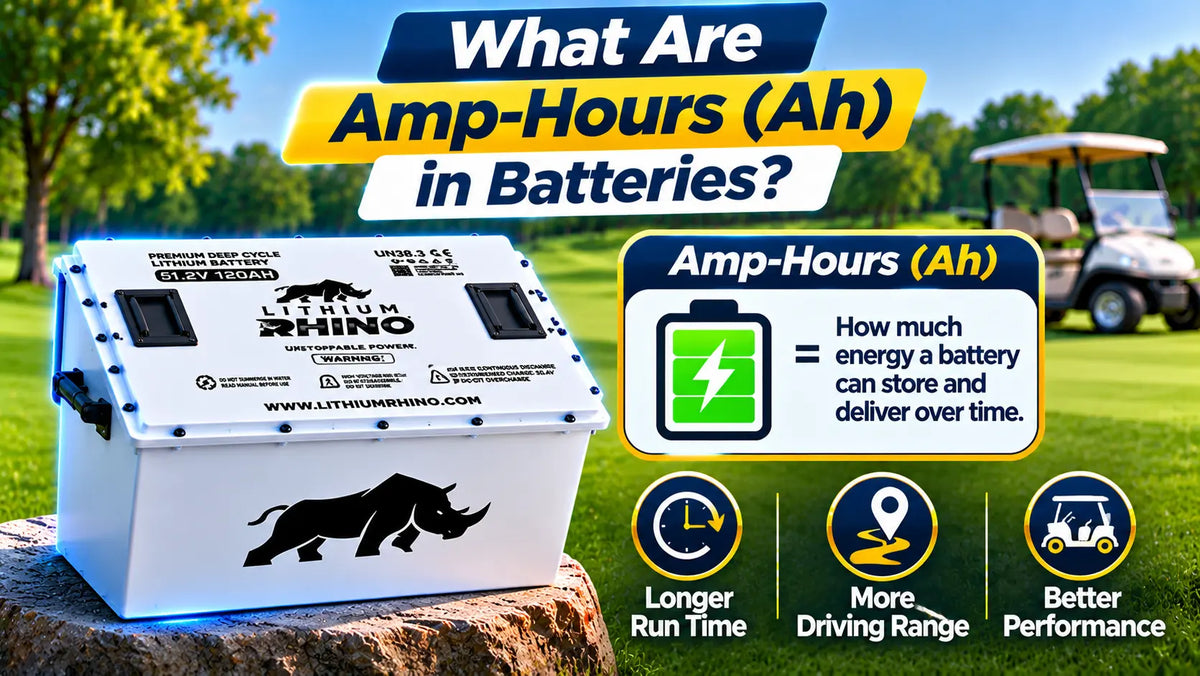
Amp-hours (Ah) measure a battery's electrical charge capacity. A 100Ah battery could theoretically supply 10 amps for 10 hours or 20 amps for 5 hours under specified test conditions. A higher Ah rating generally means more rated capacity, but actual runtime also depends on voltage, battery chemistry, usable energy, discharge rate, temperature and power demand.
What Does Ah Mean on a Battery?
Ah stands for amp-hours, a unit used to describe how much electrical charge a battery can deliver over time.
For example, a battery rated at 100Ah could theoretically provide:
- 5 amps for 20 hours
- 10 amps for 10 hours
- 20 amps for 5 hours
- 50 amps for 2 hours
These are simplified mathematical examples, not guaranteed operating times. Actual performance depends on the battery's chemistry, discharge rate, temperature, cutoff voltage, age and operating conditions.
Think of Ah as one part of a battery's capacity rating. It helps you compare how much charge batteries are designed to provide, but it does not tell you their total energy or maximum power output.
How to Calculate Amp-Hours and Battery Runtime
Amp-hours combine two measurements:
- Amps (A): The rate at which electrical current flows.
- Hours (h): The amount of time current flows.
The basic formula is:
Ah = Amps × Hours
You can rearrange it to estimate runtime:
Theoretical runtime (hours) = Battery capacity (Ah) ÷ Current draw (A)
For example, suppose a 100Ah battery supplies a constant 20A load.
100Ah ÷ 20A = 5 hours
The theoretical runtime is five hours.
However, this calculation assumes the battery can deliver its full rated capacity at that discharge rate. Real-world runtime may be shorter because of discharge limits, temperature, battery condition and changing power demand.
Theoretical Runtime Examples for a 100Ah Battery
| Current draw | Theoretical runtime |
|---|---|
| 5A | 20 hours |
| 10A | 10 hours |
| 20A | 5 hours |
| 25A | 4 hours |
| 50A | 2 hours |
| 100A | 1 hour |
Important: These figures are mathematical examples. They do not mean every 100Ah battery can safely supply every listed current or deliver its full rated capacity at each discharge rate. Check the manufacturer's continuous discharge rating and capacity-testing conditions.
Amps vs Ah vs Volts vs Watt-Hours: What's the Difference?
These measurements describe different aspects of battery performance. Understanding them helps you compare batteries more accurately.
| Measurement | Symbol | What it tells you |
|---|---|---|
| Amps | A | The rate of electrical current flow |
| Amp-hours | Ah | Electrical charge capacity |
| Volts | V | Electrical potential or system voltage |
| Watt-hours | Wh | The amount of electrical energy |
| Watts | W | The rate at which electrical power is used or delivered |
What Are Amps?
Amps measure the electrical current flowing at a particular moment.
For example, a golf cart motor may draw more current when accelerating or climbing a hill than when cruising on flat ground. The actual demand changes with the cart, motor, controller, terrain and load.
What Are Volts?
Voltage describes the electrical potential of a battery system.
Golf carts commonly use 36V or 48V electrical systems. However, a battery marketed for a 48V golf cart may have a nominal voltage of 51.2V, depending on its chemistry and cell configuration.
Always check the battery's nominal voltage and the golf cart manufacturer's compatibility requirements.
What Are Watt-Hours?
Watt-hours measure electrical energy. They combine voltage and amp-hours.
Formula: Wh = Volts × Amp-hours
For example:
51.2V × 105Ah = 5,376Wh
That equals 5.376kWh of nominal energy.
Watt-hours are useful when comparing batteries with different voltage ratings. Two batteries can have the same Ah rating but different nominal energy because their voltages differ.
Remember: Ah tells you about charge capacity, while Wh gives you a better picture of the battery's total nominal energy.
How to Compare Battery Energy Using Ah and Voltage
Looking at Ah alone can lead to an incomplete comparison. You should also consider nominal voltage and watt-hours.
Here are three mathematical examples:
| Battery | Nominal voltage | Capacity | Nominal energy |
|---|---|---|---|
| Battery A | 48V | 100Ah | 4,800Wh |
| Battery B | 51.2V | 100Ah | 5,120Wh |
| Battery C | 51.2V | 105Ah | 5,376Wh |
Battery C has the highest nominal energy in this example because it combines a 51.2V nominal voltage with a 105Ah capacity.
When comparing real products, use the manufacturer's stated nominal voltage and capacity. Do not assume that two batteries with similar marketing descriptions have identical electrical specifications.
What Is C-Rate, and Why Does It Matter?
A battery's C-rate describes how quickly it is charged or discharged relative to its rated capacity.
For a 100Ah battery:
| Discharge rate | Current | Mathematical discharge time |
|---|---|---|
| 0.2C | 20A | 5 hours |
| 0.5C | 50A | 2 hours |
| 1C | 100A | 1 hour |
| 2C | 200A | 30 minutes |
These examples show the mathematical relationship between capacity and current. They do not mean every 100Ah battery supports these discharge rates.
The battery's cells, internal design and battery management system (BMS) must be designed to handle the requested current.
For golf cart owners, this matters because the motor can demand substantially more current during acceleration, uphill driving or heavy use than it does while cruising.
Before buying a battery, check its:
- Continuous discharge current rating.
- Peak discharge current rating.
- Permitted peak duration.
- BMS operating limits.
A high Ah rating alone does not prove that a battery can safely provide the current your golf cart needs.
What Does C20 Mean on a Battery?
C20 describes a battery capacity rating measured over a 20-hour discharge period under specified test conditions.
For example, a 100Ah battery with a C20 rating is nominally tested at an average discharge current of 5A:
100Ah ÷ 20 hours = 5A
The important point is that a battery's measured capacity depends partly on how it is tested. Conditions can include discharge current, temperature and the voltage at which the test ends.
Do not assume every lithium battery uses the same C20 rating method. Check the manufacturer's datasheet for the actual test conditions when comparing batteries.
How Long Will a 100Ah Battery Last?
There is no single answer. Runtime depends on how much current or power the connected equipment uses.
For a simple current-based estimate:
Runtime (hours) = Battery capacity (Ah) ÷ Current draw (A)
A 100Ah battery supplying a constant 10A load has a theoretical runtime of 10 hours.
For applications where voltage and power demand matter, a watt-hour calculation can be more useful:
Estimated runtime (hours) ≈ Usable energy (Wh) ÷ Average power demand (W)
Example: Estimating Runtime for a 51.2V 105Ah Battery
Consider a battery with these ratings:
- Nominal voltage: 51.2V
- Capacity: 105Ah
- Nominal energy: 5,376Wh
For illustration, assume 90% of its nominal energy is available for the calculation.
5,376Wh × 0.90 = 4,838.4Wh
If the average battery-side power demand is 1,000W:
4,838.4Wh ÷ 1,000W = 4.84 hours
The estimated runtime is approximately 4.84 hours.
This is a simplified energy calculation, not a prediction of golf cart driving time. A golf cart does not draw a constant 1,000W. Its power demand changes with acceleration, hills, passengers, speed, accessories, tire pressure and driving style.
The 90% usable-energy assumption is illustrative. It is not a confirmed usable-capacity specification for every battery.
What Affects a Battery's Actual Runtime?
A battery's Ah rating does not guarantee a specific operating time. Several factors influence how much capacity is available during use.
1. Power Demand
Equipment that draws more current or power uses battery energy faster.
A golf cart climbing a steep hill may require significantly more power than one traveling slowly across flat ground.
2. Battery Chemistry
Different battery chemistries have different discharge characteristics, usable capacity, weight and charging requirements.
Lead-acid and lithium batteries should not be compared using Ah alone. Compare usable energy, discharge specifications and the conditions under which capacity was measured.
3. Temperature
Very hot or cold conditions can affect battery performance.
Always check the manufacturer's recommended operating and charging temperature ranges. Charging limits can differ from discharge limits.
4. Battery Age and Condition
Battery capacity can decline as a battery ages and goes through charge cycles.
Storage conditions, maintenance history, operating environment and usage can all influence long-term performance.
5. Battery Management System (BMS)
A lithium battery's BMS monitors and protects the battery according to its design.
Depending on the system, it may help protect against overcurrent, overvoltage, undervoltage and temperature-related conditions.
The BMS's continuous and peak current ratings are important when selecting a golf cart battery.
6. Discharge Rate
A battery's measured capacity can vary depending on how quickly it is discharged.
This is important when comparing different battery types and specifications. Review the manufacturer's testing conditions rather than assuming the advertised Ah figure will be available under every load.
How Many Amp-Hours Does a Golf Cart Need?
The right Ah rating depends on how you use your golf cart, how much range you want and what your electrical system requires.
A battery with more Ah generally offers greater rated charge capacity when compared with another battery at the same voltage and under equivalent test conditions. However, choosing a larger capacity does not automatically guarantee a particular driving range.
Consider these factors before choosing:
- Typical driving distance: Think about how far you normally travel between charges.
- Terrain: Regular hills and uneven surfaces can increase power demand.
- Passengers and cargo: Additional weight can affect energy consumption.
- Motor and controller: Your electrical system must be compatible with the battery's discharge capabilities. If you are upgrading the drivetrain, see our AC motor and controller kits.
- Tires and modifications: Larger tires and other modifications can change power requirements.
- Accessories: Lights, sound systems and other electrical equipment can add to energy demand.
- Charging routine: Consider how frequently you can recharge the cart.
65Ah vs 100Ah vs 105Ah vs 120Ah: Capacity Comparison
The following table compares theoretical nominal energy at the same 51.2V nominal voltage.
| Battery capacity | Nominal voltage | Nominal energy |
|---|---|---|
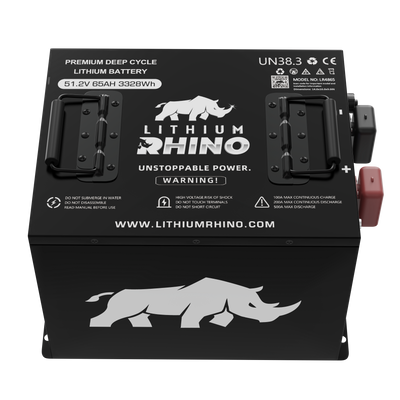
| 65Ah | 51.2V | 3,328Wh |
| 100Ah | 51.2V | 5,120Wh |
| 105Ah | 51.2V | 5,376Wh |
| 120Ah | 51.2V | 6,144Wh |
These are calculated examples, not confirmation that every battery sold at these capacities has the same voltage or usable energy.
The comparison illustrates an important point: at the same voltage, a higher Ah rating provides more nominal energy.
However, the right choice still depends on compatibility, discharge ratings, physical dimensions, usable capacity, warranty and your driving requirements.
Is a 105Ah Battery Better Than a 100Ah Battery?
A 105Ah battery has 5% more rated charge capacity than a 100Ah battery when both have the same nominal voltage and are measured under equivalent conditions.
At 51.2V:
| Specification | 100Ah battery | 105Ah battery |
|---|---|---|
| Nominal voltage | 51.2V | 51.2V |
| Capacity | 100Ah | 105Ah |
| Nominal energy | 5,120Wh | 5,376Wh |
| Energy difference | — | 256Wh more |
| Capacity difference | — | 5% higher |
The 105Ah battery provides 256Wh more nominal energy in this example.
That does not mean it will deliver exactly 5% more driving range. Actual range depends on usable energy, cart efficiency, terrain, passenger weight, speed and driving conditions.
The takeaway: A comparable 105Ah battery offers more rated capacity than a 100Ah battery, but you should also compare voltage, energy, discharge ratings, warranty and physical compatibility.
How to Read a Lithium Golf Cart Battery Specification Sheet
A battery specification sheet contains more information than its Ah rating. Knowing what each figure means can help you avoid buying a battery that does not meet your golf cart's requirements.
| Specification | What to check |
|---|---|
| Nominal voltage | Whether it matches your cart's electrical system |
| Capacity (Ah) | The battery's rated charge capacity |
| Nominal energy (Wh) | The battery's calculated or stated energy |
| Continuous discharge | Current the battery is rated to supply continuously |
| Peak discharge | Higher current available for a limited duration |
| Battery chemistry | For example, lithium iron phosphate (LiFePO4) |
| Charging requirements | Compatible charger and permitted charging conditions |
| Dimensions and weight | Whether the battery fits the available space |
| BMS protection | The battery's monitoring and protection features |
| Warranty | Coverage, exclusions, registration and claim conditions |
Do not compare batteries based on one specification. A battery may have a high Ah rating but still be unsuitable if its voltage, BMS limits, dimensions or charging requirements do not match your cart.
Example: Understanding the Lithium Rhino 48V 105Ah CUBE Battery
A real product listing can help show how Ah, voltage and watt-hours work together.
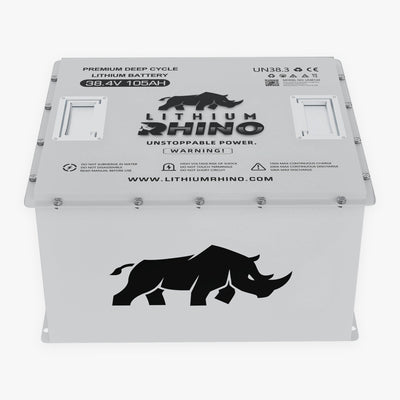
The Lithium Rhino 48V 105Ah CUBE is marketed as a 48V golf cart battery. Its published specifications identify a 105Ah capacity and a 51.2V nominal voltage.
Using those figures:
51.2V × 105Ah = 5,376Wh
That equals 5.376kWh of nominal energy.
Here is what those figures mean:
105Ah: Rated Charge Capacity
The 105Ah figure describes the battery's rated electrical charge capacity. It helps buyers compare capacity with other batteries tested under comparable conditions.
51.2V: Nominal Battery Voltage
The 51.2V figure is the nominal voltage used in the energy calculation. A battery marketed for a 48V golf cart system may have a nominal voltage of 51.2V.
Always confirm compatibility with the golf cart manufacturer's electrical requirements.
5,376Wh: Nominal Energy
The watt-hour figure combines voltage and amp-hours. It provides a more complete picture of nominal energy than Ah alone.
Why Discharge Ratings Matter
Continuous and peak discharge ratings tell buyers how much current a battery can supply under specified conditions.
These figures should be checked against the manufacturer's current technical documentation. Peak current should never be treated as a continuous discharge rating, and the permitted peak duration matters.
Why Physical Fit and Charging Requirements Matter
Capacity is only one part of choosing a replacement battery. Buyers should also confirm dimensions, mounting arrangements, wiring, charger compatibility and installation requirements.
You can review the Lithium Rhino 48V 105Ah CUBE product listing for its current product information and specifications.
Common Mistakes When Comparing Battery Amp-Hours
Avoid these mistakes when researching a replacement golf cart battery:
1. Assuming a higher Ah rating always means more energy. Voltage matters too. Compare watt-hours when evaluating nominal energy.
2. Treating amps and amp-hours as the same measurement. Amps measure current flow. Amp-hours measure electrical charge capacity over time.
3. Assuming theoretical runtime is guaranteed. Real operating conditions affect available capacity and runtime.
4. Ignoring C-rate and test conditions. Two Ah ratings may not be directly comparable if they were measured under different conditions.
5. Confusing peak and continuous discharge ratings. A battery's peak current rating does not mean it can supply that current continuously.
6. Choosing a battery without checking compatibility. Voltage, BMS limits, charger requirements, dimensions and connections all matter.
7. Comparing battery capacity without considering usable energy. Nominal capacity does not necessarily equal the energy available during every operating condition.
Frequently Asked Questions About Battery Amp-Hours
1. What does Ah mean on a battery?
Ah stands for amp-hours. It measures a battery's electrical charge capacity and indicates how much current it can supply over time under specified conditions.
2. Is a higher Ah battery better?
A higher Ah rating generally means greater rated charge capacity when comparing batteries at the same voltage and under equivalent test conditions. However, you should also compare watt-hours, discharge ratings, chemistry and compatibility.
3. How long will a 100Ah battery last?
It depends on the current or power demand. A 100Ah battery theoretically supplies 10A for 10 hours or 20A for 5 hours. Actual runtime depends on the battery and operating conditions.
4. What is the difference between Ah and Wh?
Ah measures electrical charge capacity, while Wh measures electrical energy. To calculate nominal energy, multiply voltage by amp-hours.
5. Is a 100Ah battery enough for a golf cart?
It may be suitable for some golf carts, but capacity alone cannot determine suitability. Check your cart's voltage, expected driving requirements, motor demands, battery energy and continuous discharge rating.
6. What does 105Ah mean on a golf cart battery?
A 105Ah rating indicates the battery's rated charge capacity. At the same voltage and under comparable test conditions, it offers 5% more rated charge capacity than a 100Ah battery.
7. How many watt-hours are in a 51.2V 105Ah battery?
Multiply 51.2V by 105Ah to get 5,376Wh, or 5.376kWh, of nominal energy.
8. What is the difference between 48V and 51.2V batteries?
A battery marketed for a 48V system may have a nominal voltage of 51.2V, depending on its chemistry and cell configuration. Always check the battery manufacturer's specifications and your golf cart's compatibility requirements.
9. What does C20 mean on a battery?
C20 describes a capacity rating measured over a 20-hour discharge period under specified test conditions. For a 100Ah C20 rating, the nominal test current is 5A over 20 hours.
10. Does a higher Ah rating increase golf cart range?
It can provide more rated capacity and potentially support longer driving time, provided the battery and vehicle specifications are suitable. Actual range also depends on terrain, speed, passengers, tires, temperature and driving habits.
11. What is the difference between continuous and peak discharge current?
Continuous discharge is the current a battery is rated to supply continuously under specified conditions. Peak discharge is a higher current available for a limited period. Check the manufacturer's documentation for the permitted peak duration.
12. Can I replace a lead-acid golf cart battery with a lithium battery with the same Ah rating?
Not automatically. You must confirm voltage compatibility, charger requirements, BMS discharge limits, physical fit, wiring and the cart manufacturer's requirements. Equal Ah ratings do not guarantee identical performance.
13. Do lithium batteries deliver their full rated Ah capacity?
Actual delivered capacity depends on the battery design, discharge rate, temperature, cutoff settings, age and test conditions. Check the manufacturer's datasheet for the conditions used to establish the rating.
14. Does temperature affect battery capacity?
Yes. Temperature can affect available capacity, charging performance and battery operation. Follow the manufacturer's specified temperature limits for both charging and discharging.
15. What should I compare when buying a lithium golf cart battery?
Compare nominal voltage, Ah, Wh, continuous and peak discharge current, chemistry, cycle-life rating, charger compatibility, physical dimensions, warranty terms and customer support.
Ah Is Important, but It Is Not the Whole Story
Amp-hours help you understand a battery's rated charge capacity, but they should never be the only specification you consider when buying a golf cart battery.
For a more accurate comparison, look at nominal voltage, watt-hours, continuous discharge current, peak discharge limits, battery chemistry and compatibility with your cart.
If you are comparing lithium golf cart batteries, evaluate these specifications together rather than choosing the battery with the biggest Ah number. This gives you a clearer understanding of what the battery can actually support.
Related reading
- 48V vs 72V Lithium Golf Cart Batteries: Which Should You Choose?
- How Much Do Golf Cart Batteries Cost?
- How Long Do 48 Volt Golf Cart Batteries Last?
Looking for a lithium battery upgrade? Explore the Lithium Rhino 48V 105Ah CUBE and review its current specifications to see whether it matches your golf cart's requirements.


Leave a comment
This site is protected by hCaptcha and the hCaptcha Privacy Policy and Terms of Service apply.