

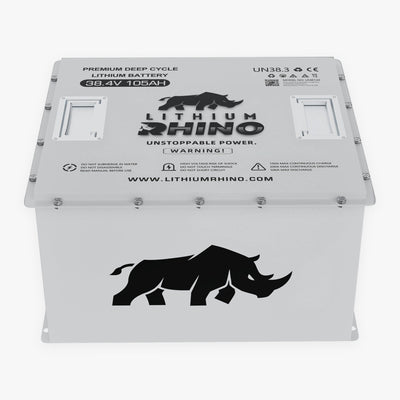
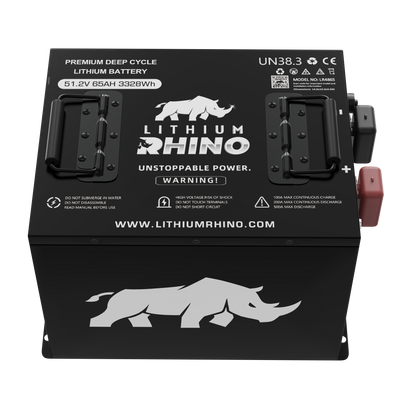
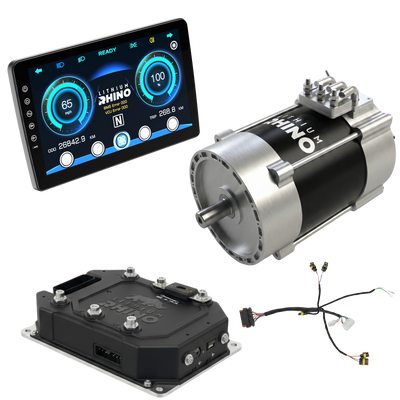

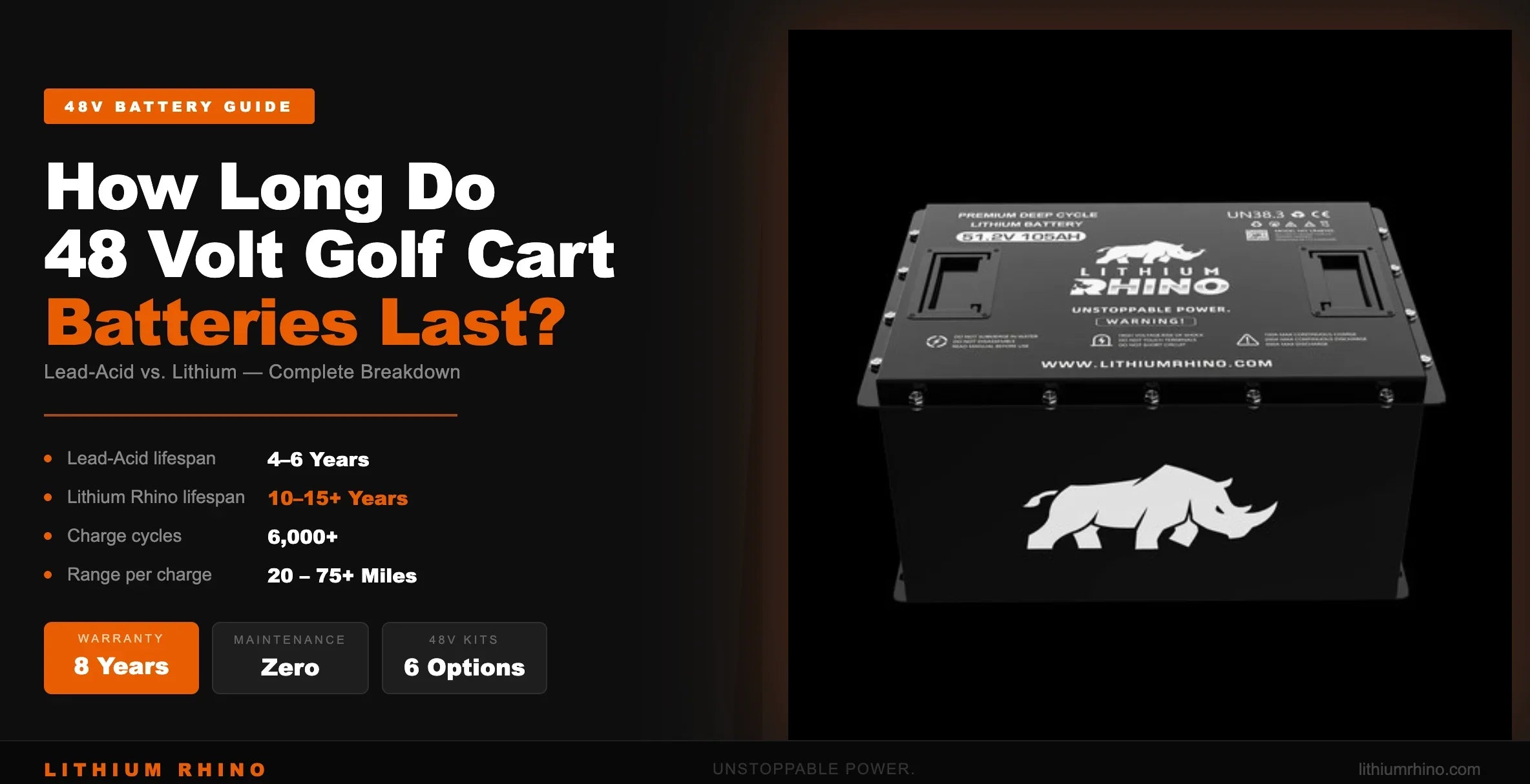
Lead-acid golf cart batteries typically last 4 to 6 years. Lithium golf cart batteries like those from Lithium Rhino last 10 to 15 years or longer, with a 6,000+ charge cycle life.
But the real answer is more nuanced. How you charge, how often you ride, where you store your cart, and whether you maintain your batteries all have a massive impact on golf cart battery lifespan.
In this guide, we'll break down everything you need to know including the warning signs your batteries are dying, proven tips to extend battery life, and when it finally makes sense to stop replacing lead-acid and switch to lithium for good.
Golf Cart Battery Lifespan by Battery Type
Not all golf cart batteries are created equal. Here's a clear comparison of the most common types:
Lead-Acid (Flooded) Batteries - 4 to 6 Years
This is what most golf carts come with from the factory. Lead-acid batteries are affordable upfront but demand regular maintenance, you have to check and refill water levels, clean terminals, and keep them on a proper charge schedule.
Skip even a few of these steps and you'll be lucky to get 3 years out of them. Do everything right and 5 to 6 years is achievable.
AGM Batteries (Sealed Lead-Acid) - 4 to 7 Years
AGM (Absorbent Glass Mat) batteries are maintenance-free sealed lead-acid batteries. They're slightly more forgiving and better suited for irregular use. However, they still share the fundamental limitations of lead-acid chemistry, degrading performance as charge drops, sensitivity to deep discharges, and relatively short overall lifespan compared to lithium.
Lithium Iron Phosphate (LiFePO4) Batteries - 10 to 15+ Years
This is where things get serious. Lithium batteries specifically LiFePO4 chemistry have a fundamentally longer lifespan than lead-acid, measured in charge cycles rather than just years.
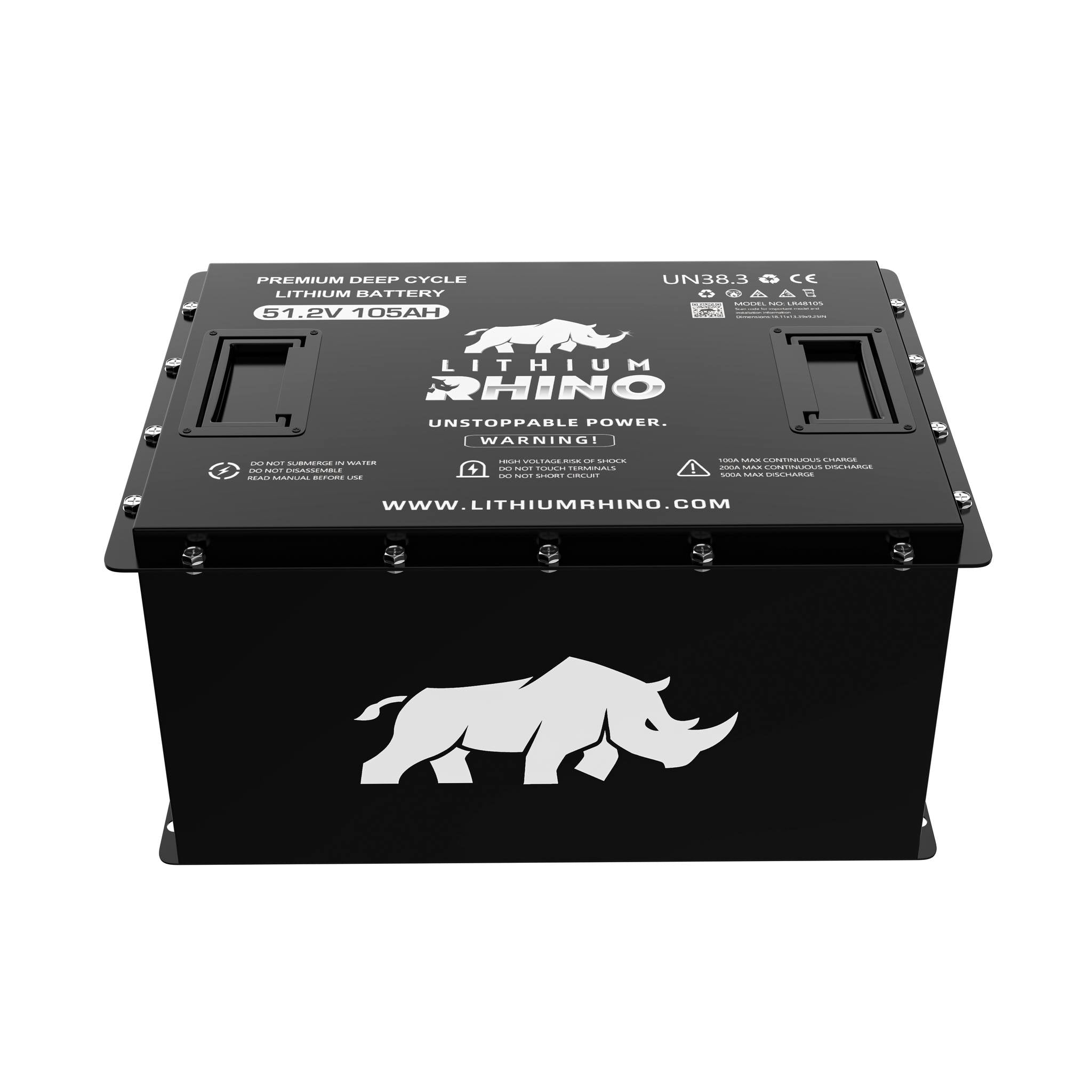
Lithium Rhino batteries are rated for 6,000+ charge cycles. At one charge per day, that's over 16 years of daily use. Even with heavier riding habits, you're realistically looking at a decade or more of reliable performance. That's why Lithium Rhino backs their batteries with an 8-year warranty, the longest in the industry.
How Many Years Do Golf Cart Batteries Last? (A Realistic Breakdown)
| Battery Type | Average Lifespan | Charge Cycles | Maintenance |
|---|---|---|---|
| Flooded Lead-Acid | 4–6 years | 500–1,000 cycles | High (monthly) |
| AGM Sealed | 4–7 years | 500–1,200 cycles | Low |
| Lithium (LiFePO4) | 10–15+ years | 6,000+ cycles | None |
One thing most people don't realize is that lead-acid batteries don't just die suddenly — they slowly lose capacity over time. After two or three years, you're already getting noticeably less range per charge. With lithium, performance stays consistent right up until the end of its lifespan.
As one Lithium Rhino customer put it: "360 pounds replaced by a 40-pound power pack, ready to answer all your golf cart needs." Weight, range, and performance, lithium wins on every metric.
What Affects Golf Cart Battery Life Expectancy?
Even the best battery can die early if you're making avoidable mistakes. These are the biggest factors that determine how long your golf cart batteries actually last:
1. Charging Habits
How you charge is probably the single biggest factor in battery longevity.
- Lead-acid batteries should be charged after every use, even if you only drove a few minutes. Leaving them in a discharged state causes sulfation - a chemical buildup on the plates that permanently reduces capacity.
- Never overcharge lead-acid batteries. Without a smart charger, this is easy to do.
- Lithium batteries are more forgiving. They don't suffer from sulfation, tolerate partial charging well, and come with built-in Battery Management Systems (BMS) that prevent overcharging and over-discharging automatically.
Lithium Rhino's conversion kits include a 25-amp smart charger that automatically shuts off when the battery is full, one less thing to worry about.
2. Depth of Discharge
With lead-acid batteries, regularly draining below 50% dramatically shortens lifespan. This is why your range seems to shrink year after year, you're burning through your rated cycles much faster with deep discharges.
Lithium batteries handle deep discharges far better. Most LiFePO4 batteries can safely discharge to 80–90% depth without degradation, giving you more usable capacity and less battery wear.
3. Storage and Temperature
Storing your cart especially over winter, without proper battery care is one of the fastest ways to destroy lead-acid batteries.
- Lead-acid batteries self-discharge and can freeze if left discharged in cold storage.
- They should be stored fully charged and re-charged every 30–45 days during long storage periods.
- Lithium batteries self-discharge much more slowly (about 2–3% per month versus 15–30% for lead-acid) and are far more tolerant of storage conditions.
Lithium Rhino even offers models with self-heated charging technology, allowing the battery to warm itself to 32°F before charging begins making them genuinely usable in cold climates year-round.
4. Riding Frequency and Load
Using your cart heavily hilly terrain, heavy loads, frequent long trips puts more demand on batteries and accelerates wear. This doesn't mean you should use your cart less. It means the right battery matters.
Lithium Rhino's batteries deliver 200A continuous discharge current with up to 500A peak discharge for 30 seconds, handling hills and demanding terrain without the voltage drop that lead-acid experiences as charge levels decrease.
5. Maintenance (or Lack of It)
Lead-acid batteries require monthly water top-offs, periodic terminal cleaning, and careful attention to charge levels. Neglect this and you shave years off battery life.
Lithium batteries require zero maintenance. No water. No terminal cleaning. No charge anxiety. Just ride.
Signs Your Golf Cart Batteries Are Dying
Don't wait until your cart stops dead on the 9th fairway. Watch for these warning signs that your batteries need replacement soon:
1. Noticeably Shorter Range Per Charge If your cart used to handle 18 holes comfortably and now struggles to make 9, your batteries are losing capacity. This is the most common and earliest warning sign.
2. Slow or Sluggish Acceleration Healthy batteries deliver power consistently. Dying batteries hesitate, especially from a stop or going uphill.
3. The Cart Slows Down as Battery Level Drops With lead-acid batteries, performance drops as charge decreases. If your cart is noticeably slower at 50% charge than at 100%, the batteries are on their way out. (This doesn't happen with lithium — you get full power from 100% all the way down to about 20%.)
4. Batteries Take Much Longer to Charge — or Won't Hold Charge If charging sessions are significantly longer than they used to be, or if the batteries seem to drain within hours of charging, they've likely lost most of their capacity.
5. Visible Damage — Swelling, Leaking, or Corrosion Cracked cases, leaking acid, terminal corrosion, or swollen battery cases are immediate replacement signals. These can also pose safety risks.
6. Cart Batteries Are 4+ Years Old Even if you don't notice dramatic performance changes, lead-acid batteries over four years old are living on borrowed time. It's worth testing them and planning for replacement proactively.
How Often Should You Replace Golf Cart Batteries?
For lead-acid batteries, most golf cart owners replace them every 4 to 6 years — sometimes sooner if they're used heavily or maintained poorly.
The problem? Every time you replace lead-acid, you're spending $800–$1,500+ for maybe 4 more years. Over a 15-year period, that's 3 or more replacement cycles and thousands of dollars — not counting labor, the ongoing cost of a compatible charger, and the hours spent on maintenance.
Lithium batteries change this math entirely. A Lithium Rhino conversion kit is a one-time investment — backed by an 8-year warranty — that outlasts multiple lead-acid replacement cycles. After 8–10 years, your lithium battery is still performing strongly, while a lead-acid pack would already have been replaced twice.
"It's time to ditch the lead-acids once and for all. Grab yourself a Lithium Rhino and never buy another battery."
How to Extend Golf Cart Battery Life
Whether you're trying to squeeze more life out of your current lead-acid batteries or maximize the already-impressive lifespan of your lithium battery, these habits make a real difference:
For Lead-Acid Batteries:
- Charge after every use - don't let them sit discharged
- Check and refill water levels monthly with distilled water
- Keep terminals clean and lightly coated with terminal protector spray
- Store fully charged, and trickle-charge every 30–45 days during long storage
- Avoid discharging below 50% capacity
- Use a quality smart charger designed for your battery voltage
For Lithium Batteries:
- Charge regularly — but don't stress if you miss a cycle
- Allow the BMS to manage the battery (don't override it)
- Store in a dry, moderate-temperature environment
- Use only the charger provided or specifically recommended by the manufacturer
- Connect via Bluetooth app (if equipped) to monitor battery health in real time
Lithium Rhino batteries come with an intelligent BMS that continuously monitors and adjusts battery parameters while you drive — automatically protecting against overcharging, over-discharging, short circuits, and overheating. The battery essentially takes care of itself.
Lead-Acid vs. Lithium: The Total Cost of Ownership
Here's a question worth asking: What's the real cost of sticking with lead-acid?
| Lead-Acid (15 Years) | Lithium Rhino (15 Years) | |
|---|---|---|
| Replacement Cycles | 2–3 times | 0 (still going strong) |
| Total Battery Cost | $2,400–$4,500+ | One-time investment |
| Maintenance Hours | Significant | Zero |
| Range Per Charge | Declining over time | Consistent throughout |
| Weight | ~300+ lbs | ~40–63 lbs |
| Warranty | 1–2 years | 8 years |
The upfront cost of lithium looks higher. Zoom out 5–10 years and the math flips hard in lithium's favor.
Why Lithium Rhino? The Difference Is in the Details
If you're ready to make the switch, Lithium Rhino's conversion kits are designed to make it effortless — even if you've never done anything mechanical in your life.
- Compatible with all major brands — EZ-GO, Club Car, Yamaha, ICON, Bad Boy Buggies, GEM cars, and more
- Drop-in installation — most conversions take under an hour with the included hardware, wiring, and instructions
- Free 30-minute video call with a certified tech, included with every purchase
- 6,000+ charge cycle life with a robust 8-year warranty
- Up to 50+ miles per charge (depending on model)
- 4x lighter than lead-acid — improves speed, acceleration, and reduces long-term wear on your cart's frame and suspension
- Self-heated models available for year-round cold-climate use
- Bluetooth app for real-time battery monitoring from your phone
Frequently Asked Questions
How long do golf cart batteries last on a single charge?
With a Lithium Rhino battery, expect 20 to 50+ miles per charge depending on the model. Lead-acid batteries typically offer 15 to 25 miles but this range degrades significantly as the battery ages.
How many years do golf cart batteries last?
Lead-acid batteries last 4 to 6 years on average. Lithium Iron Phosphate batteries like Lithium Rhino's are rated for 6,000+ charge cycles - translating to 10 to 15+ years of real-world use.
What kills golf cart batteries faster than anything else?
Leaving lead-acid batteries in a discharged state is the fastest way to kill them. Sulfation builds up on the plates and permanently reduces capacity. Deep, repeated discharges below 50% also dramatically shorten lifespan.
Can I replace just one bad golf cart battery instead of all of them?
Not recommended for lead-acid. Mismatched batteries even slightly different ages - cause uneven charging and faster overall pack degradation. Replace the full set. With lithium, you have just one battery unit to replace.
Is it worth switching to lithium batteries for a golf cart?
For most golf cart owners especially those planning to keep their cart for more than 5 years yes, the switch to lithium is well worth it. The total cost of ownership, performance gains, and zero maintenance make it the smarter long-term choice.
How do I know if my golf cart batteries are dying?
Shorter range per charge, sluggish acceleration, slow charging, and reduced top speed at lower charge levels are the primary warning signs. Batteries over 4 years old showing any of these symptoms are likely nearing end of life.
The Bottom Line
If you've got lead-acid batteries and they're performing fine, take care of them but start planning. The average golf cart battery lifespan for lead-acid is 4 to 6 years, and even well-maintained packs will eventually reach their limit.
When that day comes, don't just replace like-for-like. The smarter move, the one that saves money, eliminates maintenance, and genuinely transforms how your cart performs is converting to lithium.
Lithium Rhino makes that conversion simple, fast, and backed by the best warranty in the business.
👉 Shop Lithium Rhino Conversion Kits and find the right fit for your cart today.

Leave a comment
This site is protected by hCaptcha and the hCaptcha Privacy Policy and Terms of Service apply.