

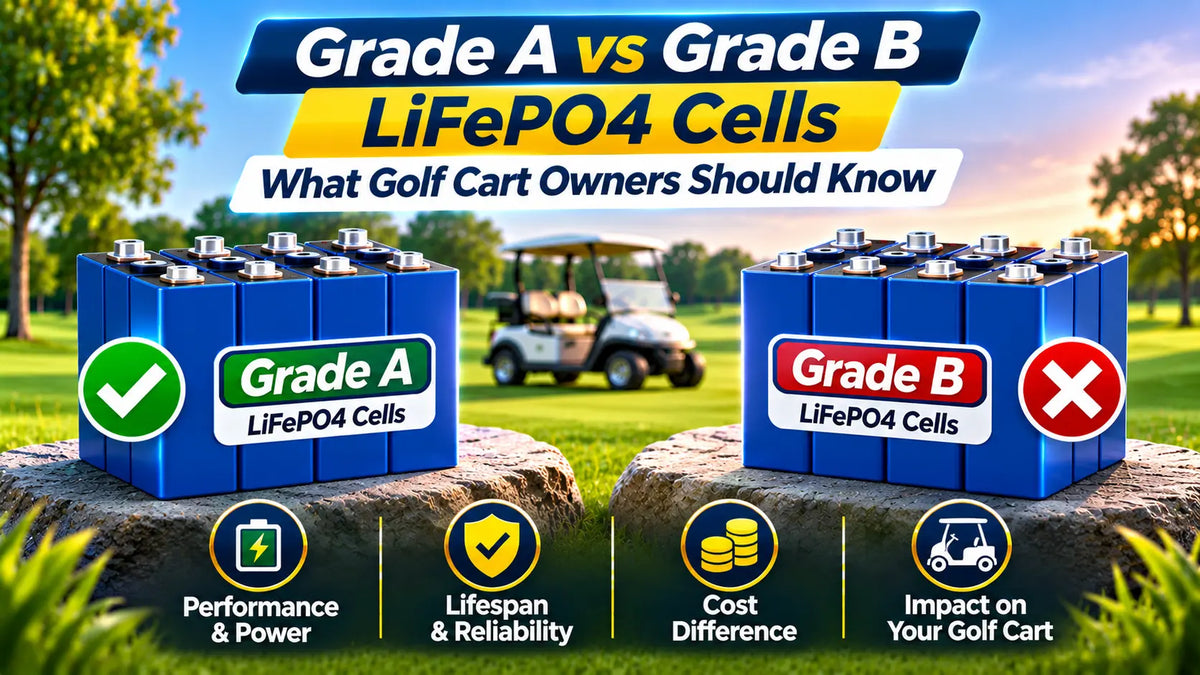
“Grade A” and “Grade B” are factory sorting labels, not an official standard. Grade A cells meet the maker’s targets for capacity, internal resistance and consistency. Grade B cells miss one or more of those targets, or come from surplus, aged or reclaimed stock.
In a golf cart, the difference matters more than in most products. A 48V pack wires 16 cells in series, so one weak cell sets the range of the whole battery. A single cell that is 10Ah short can cost you about 10% of your range.
Before you buy, ask for the cell maker, model, QR traceability code and factory test data. Don’t rely on the label.
What “Grade A” actually means
No global or mandatory standard defines LiFePO4 cell grades. One supplier’s “Grade A” can be closer to another supplier’s “Grade B” (SunLith Energy). Cell factories test every cell after production and sort them by four things:
- Capacity: does the cell meet or exceed its rated amp-hours?
- Internal resistance: is it low and close to the rest of the batch?
- Self-discharge and voltage: does it hold charge like its batch-mates?
- Appearance: are the casing, terminals and QR code free of defects?
Cells that pass become Grade A and go to EV, energy-storage and pack makers. Cells that fall outside the targets are downgraded. Grade B also includes aged inventory and cells recovered from disassembled modules (EVLithium).
The reason for a downgrade matters. A cell marked down for a scuff on its casing is very different from one that missed its capacity target or loses charge too quickly on the shelf. A “Grade B” label alone does not tell you which one you are getting.
Grade A vs Grade B at a glance
| Grade A | Grade B | |
|---|---|---|
| Source | Passed the cell maker’s factory sorting | Failed sorting, surplus, aged or reclaimed stock |
| Capacity | Meets or exceeds the datasheet | Often slightly below, or unknown |
| Internal resistance | Low and tightly matched across the batch | Higher, or wider spread across cells |
| QR traceability code | Original, laser-engraved, in the datasheet position | Often scraped off or replaced with a smaller code |
| Test data | Factory test report available | Usually none |
| Aging | Cells age at a similar pace | Faster capacity fade and wider drift |
| Price | Full price | Commonly sold 30–40% cheaper (LiFePO4 Australia) |
Typical differences reported by cell suppliers. Because grading is not standardized, check the actual data for any cell you buy.
New Grade B cells can look and test almost the same as Grade A. One authorized EVE reseller says the grades are nearly impossible to tell apart by appearance when new, and that the real difference shows up over the battery’s lifespan (LiFePO4 Australia). That is why a cheap pack can feel fine on day one and fall short in year two.
Why one weak cell matters in a golf cart
A 48V golf cart battery contains 16 LiFePO4 cells in series. A 72V-class pack contains 22 to 24. In a series string, every cell carries the same current, and the pack stops when any single cell reaches its voltage limit. So the weakest cell sets the capacity of the whole pack.
Texas Instruments’ guidance on cell balancing explains that a capacity mismatch in a series string ties pack capacity to the weakest cell (TI application note via Mouser). Researchers at the University of Luxembourg found the problem grows with use: weaker cells are cycled more deeply, so the spread between cells widens over time (University of Luxembourg).
Worked example: one cell, 10% less range
Take a 48V 105Ah pack built from 16 cells.
| All 16 cells at 105Ah | 15 cells at 105Ah + 1 cell at 95Ah | |
|---|---|---|
| Usable pack capacity | 105Ah | 95Ah |
| Usable energy (51.2V nominal) | 5,376Wh | 4,864Wh |
| Change in range | Baseline | About 10% less |
Fifteen good cells cannot make up for the one weak cell. When it empties, the battery management system (BMS) stops the discharge to protect it, and the other 15 cells still hold charge the cart cannot use. If your cart normally covers 40 miles, that one cell costs you about 4 of them.
Internal resistance shows up on hills
When your cart accelerates, climbs a grade or carries a full load, the pack can deliver hundreds of amps. Every cell loses some voltage in proportion to its internal resistance, and turns that loss into heat. A cell with higher resistance sags further and runs warmer than its neighbors.
On a steep hill, that cell can hit the low-voltage cutoff first, and the BMS may cut power even though the pack still has charge. Over time, the extra heat also speeds up that cell’s aging, which widens the gap even further.
What the research says about cell-to-cell variation
Peer-reviewed studies show both why tight sorting matters and why sorting alone is not enough.
Well-made cells start very close together. A Technical University of Munich team measured 1,100 fresh commercial LiFePO4 cells from two production batches. Capacity varied by only 0.28% and impedance by 0.72% (Rumpf et al., Journal of Energy Storage, 2017). That is the consistency a Grade A batch from a tier-one factory should deliver.
Small differences grow with age. University of Hawaii researchers found that even cells with small initial differences diverged significantly as they aged, because each degraded at its own pace (Devie, Baure & Dubarry, Energies, 2018).
Variation is normal, even in good cells. Testing by Chalmers University and Volvo Group found typical variance of about 10% of the capacity lost at any point during aging (Frenander & Thiringer, Journal of Energy Storage, 2024).
Production tolerances shape aging. RWTH Aachen researchers linked production-caused variation to differences in how cells lose capacity over time (Baumhöfer et al., Journal of Power Sources, 2014).
The takeaway: start with the most tightly matched cells available, then rely on a BMS that keeps them balanced for the life of the pack. Grade B cells start further apart, so they have less margin before the weakest cell drags the whole battery down.
How to check the cells before you buy
You usually cannot see the cells inside a sealed golf cart battery. Ask the seller these questions instead:
- Who made the cells, and what model are they? A credible seller names the factory and the cell model. “Grade A cells” with no maker named is a red flag.
- Can you show the cell QR codes? Genuine prismatic LiFePO4 cells carry a laser-engraved QR code in the position shown on the maker’s datasheet. Its first three characters identify the manufacturer, such as 001 for CATL and 04Q for EVE Power (LiFePO4 Australia vendor code list). A scraped-off original code with a smaller replacement elsewhere is a common sign of Grade B stock (EVreporter). A QR code alone does not prove Grade A, though.
- Is there a factory test report? Ask for capacity, internal resistance and voltage data for the batch.
- Were the cells matched for the pack? Cells in one pack should come from one batch and be sorted for capacity and resistance.
- Why were the cells graded the way they were? If a seller admits to Grade B cells, ask whether the downgrade was cosmetic or electrical.
- What does the warranty say? A long, clearly written warranty is the seller’s own bet on its cells. Check how many years are fully covered and how many are prorated.
Printable checklist: golf cart battery cell quality
Use this checklist when comparing any two lithium golf cart batteries.
| Check | Battery 1 | Battery 2 |
|---|---|---|
| Cell maker named | ☐ Yes ☐ No | ☐ Yes ☐ No |
| Cell model named | ☐ Yes ☐ No | ☐ Yes ☐ No |
| QR codes shown, vendor code matches maker | ☐ Yes ☐ No | ☐ Yes ☐ No |
| Factory test data available | ☐ Yes ☐ No | ☐ Yes ☐ No |
| Cells matched from one batch | ☐ Yes ☐ No | ☐ Yes ☐ No |
| App shows per-cell voltage | ☐ Yes ☐ No | ☐ Yes ☐ No |
| BMS cell-balance accuracy published | ☐ Yes ☐ No | ☐ Yes ☐ No |
| Years of full warranty coverage | ____ years | ____ years |
| Years of prorated coverage | ____ years | ____ years |
The more “No” answers a battery collects, the less evidence you have about what is inside it.
Already own a lithium battery? Watch the cell voltages
If your battery has an app that shows per-cell voltage, check it after a full charge and again after a long drive. In a healthy pack, the cells stay close together. If one cell keeps finishing higher on charge or lower on discharge, and the gap grows over several weeks, contact the manufacturer before your range starts to drop.
Avoid opening a sealed battery to inspect the cells yourself. Most manufacturers exclude opened batteries from warranty coverage; ours excludes opening the top lid or casing (Lithium Rhino warranty).
What’s inside a Lithium Rhino
Here is how our own batteries answer the checklist:
- Cells: Our 48V kits use Grade-A LiFePO4 prismatic cells rated for 6,000+ charge cycles. Our 76V kits use 24 Grade-A EVE cells (48V 105Ah kit, 76V 105Ah kit).
- Factory: Our batteries are designed and engineered in North Carolina by Founder and CEO Michael McDonald and manufactured at our facility in Shenzhen, China. We hold an ownership interest in that factory, which gives us a say in everything from raw materials to final testing (our story).
- Balancing: Our BMS is rated for ±20mV cell-balance accuracy.
- Monitoring: The free Rhino app on iOS and Android shows live state of charge, voltage and temperature for each cell, plus fault alerts and cycle history. You can watch your pack’s cell balance yourself, and our team can use the app for remote diagnostics and troubleshooting.
- Warranty: An 8-year limited warranty on cells, BMS and built-in electronics. For the first 6 years, repair or replacement and shipping are covered. In years 7–8 there is a flat $500 deductible. Register within 120 days of purchase; unregistered batteries are covered for one year.
Want to know more about the cells in the kit you are considering? Ask us before you buy.
Frequently asked questions
Is there an official standard for Grade A LiFePO4 cells?
No. Each factory grades cells against its own internal targets for capacity, internal resistance, self-discharge and appearance. That is why the cell maker and model matter more than the words “Grade A.”
Are Grade B LiFePO4 cells unsafe?
Not automatically. The reason for the downgrade matters. A cell marked down for a cosmetic flaw is very different from one that missed its capacity target or self-discharges too fast. The bigger risk in a golf cart is inconsistency. Cells that start further apart tend to drift further apart, which shortens the life of a series pack.
How much range can one weak cell cost?
In a 16-cell, 48V pack, the whole battery is limited to the weakest cell’s capacity. One 95Ah cell in an otherwise 105Ah pack cuts usable energy from 5,376Wh to 4,864Wh, about 10% less range.
How can I tell if a battery uses Grade A cells?
Ask for the cell maker, model, QR codes and factory test report. Check that each QR code is laser-engraved and in the datasheet position, and that its vendor code matches the claimed maker. A seller who cannot provide any of this is not giving you verifiable Grade A cells.
Does Grade A guarantee the advertised cycle life?
No. Cycle life also depends on temperature, charge and discharge rates, depth of discharge and BMS balancing. Grade A cells give you the best starting point, not a guaranteed result.
Can I open my golf cart battery to check the cells?
We don’t recommend it. Opening a sealed pack is a safety risk, and most warranties, including ours, exclude batteries with an opened lid or casing. Use the battery’s app or ask the manufacturer for cell data instead.
Grade A vs Grade B LiFePO4 Cells for Golf Carts
“Grade A” on a listing is a claim, not a specification. In a golf cart, where one weak cell can cost you a tenth of your range, what matters is evidence. You want to know who made the cells and whether they were matched for your pack. You also want a balancing BMS and a written warranty behind them.
Related reading
- 48V vs 72V Lithium Golf Cart Batteries: Which Should You Choose?
- Why Choose Lithium? Top Benefits of Golf Cart Lithium Battery Explained
- How Long Do Golf Cart Batteries Last?
- How Much Do Golf Cart Batteries Cost?
Use the checklist above on any battery you are considering. Have questions about the cells in one of our kits? Call or text (813) 336-2457, email support@lithiumrhino.com, or browse our 48V conversion kits and 72V conversion kits.


Leave a comment
This site is protected by hCaptcha and the hCaptcha Privacy Policy and Terms of Service apply.