


Choose 48V if your cart is a stock 48V cart and you want more range, less weight and zero maintenance. Choose 72V only if your cart was built for 72V, or if you are also upgrading the controller and solenoid to handle it. A 72V-class pack gives more speed and power, but it is not a drop-in swap for a 48V cart. For most owners, 48V lithium is the better buy. For lifted carts, heavy loads and serious hills, 72V is worth the extra cost if the rest of the drivetrain is rated for it.
48V vs 72V at a glance
The two systems differ in voltage, cost and what else on the cart they demand. The figures below use our own 105Ah kits as a like-for-like example.
| 48V lithium | 72V-class lithium | |
|---|---|---|
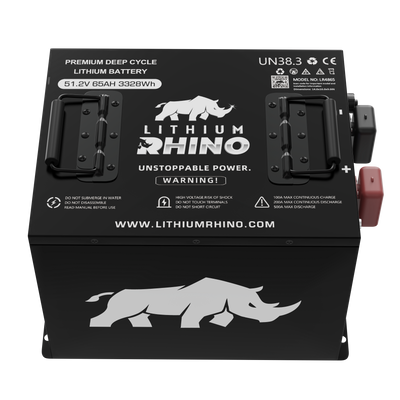
| Nominal voltage | 51.2V (16 LiFePO4 cells) | 70.4V–76.8V depending on brand (22–24 cells) |
| Full-charge voltage | 58.4V | Up to 87.6V on a 24-cell pack |
| Energy, 105Ah pack | 5,376Wh | 8,064Wh (76.8V × 105Ah) |
| Fits a stock 48V cart | Yes, with a matched charger | No, needs a 72V-rated controller and solenoid at minimum |
| Speed and torque | Strong upgrade over lead-acid | Highest, if the controller and motor allow it |
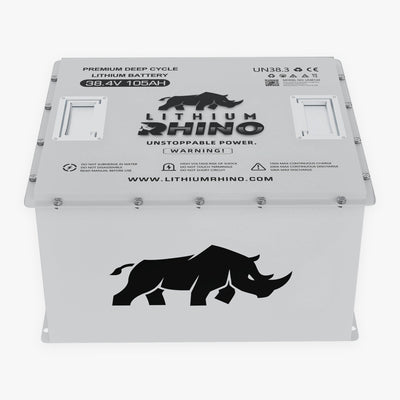
| Lithium Rhino 105Ah kit price | $2,299 | $3,199 (self-heated) |
| Best for | Neighborhood driving, course use, most street carts | Lifted carts, 6-passenger carts, steep terrain, factory 72V carts |
What changes when you raise the voltage
Speed
On a DC drivetrain, a motor’s top speed rises roughly in step with the voltage it receives. That is why 72V carts are faster. But the controller decides how much of that voltage reaches the motor, and many controllers are programmed or speed-limited. A 72V battery behind a speed-limited controller will not make the cart faster.
Power and hill climbing
Power is voltage multiplied by current. Our 48V 105Ah pack has a 200A continuous BMS, which at 51.2V is about 10.2kW. Our 76V 105Ah pack has a 300A continuous BMS, which at 76.8V is about 23kW (product page). That headroom matters on steep grades, with big tires or with six passengers. Your controller still sets the real ceiling.
Efficiency and heat
At the same power, a higher-voltage system draws less current. Less current means less heat in cables, connectors and motor windings, because resistive loss rises with the square of the current. This is the same reason passenger EV makers are moving from 400V to 800V platforms. An IEEE review of 800V powertrains explains that lower current reduces cable size and losses (Aghabali et al., IEEE Transactions on Transportation Electrification, 2021). For the same reason, doubling voltage can cut motor copper losses by about a factor of four (Electronic Design).
Applied to a golf cart: moving from 51.2V to 76.8V cuts current by a third at the same power. That reduces resistive losses by roughly 56%. In practice, this shows up as cooler cables and steadier performance under heavy load.
Range
Range depends on stored energy (Wh) and how hard you drive. A 76.8V 105Ah pack stores 50% more energy than a 51.2V 105Ah pack. Faster driving uses more energy per mile, though. That is why we quote roughly the same 40–50 miles of range for both our 48V 105Ah and 76V 105Ah kits. If range is your only goal, a larger 48V pack is usually the cheaper route. Our 48V 170Ah kit stores 8,704Wh.
Can your cart actually run 72V?
A 72V battery in a cart built for 48V is not an upgrade; it is a fault waiting to happen. Before buying 72V, check every item below:
- Controller maximum voltage. Rated for “72V” is not enough. It must accept the pack’s full-charge voltage. A 24-cell, 76.8V pack charges to about 87.6V.
- Solenoid. It must be rated for 72V and for your controller’s current. Heavy-duty 72V solenoids, for example, are sold as incompatible with 48V and 36V carts (Golf Cart Tire Supply).
- Motor. Most stock golf cart motors are designed for 36V or 48V. Confirm the motor can handle the higher voltage and RPM, or plan to replace it.
- 12V converter. Check its input range on the label. Many accept only up to about 60V. Our 72V-class kits include a 50A 12V reducer for this reason.
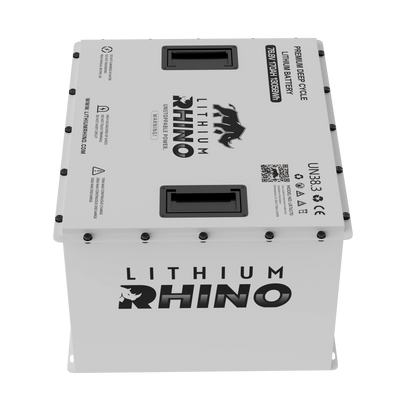
- Battery tray. Higher-capacity 72V packs are physically large. Our 76V 170Ah pack measures 21 × 18 × 12.2 inches. It fits TXT-size trays such as Bad Boy Buggies, but other carts may need tray changes (product page).
- Charger and charge port. Use only the charger matched to the pack’s voltage.
If your cart came from the factory as a 72V cart, most of this is already done. If it is a stock 48V cart, budget for at least a controller and solenoid, and possibly a motor.
The real cost of going 72V
For a factory 72V cart, the comparison is simple. Our 76V 105Ah kit costs $900 more than the 48V 105Ah kit, and it adds self-heating, a 300A BMS and 50% more stored energy.
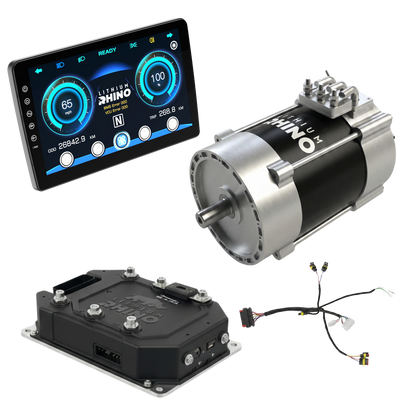
For a 48V cart, the battery is only part of the bill. Add a 72V-rated controller, a 72V solenoid (heavy-duty units start around $129) and possibly a motor, plus installation. If you are replacing the motor and controller anyway, it is worth asking about our AC motor and controller conversion kits for EZ-GO TXT and Club Car. Plan the drivetrain and battery together so every part is rated for the same system.
The 25 mph question: speed and street-legal status
Speed has legal consequences. Federal rules define a low-speed vehicle (LSV) as a four-wheeled vehicle with a top speed above 20 mph and no more than 25 mph, and LSVs must meet the safety standards in 49 CFR 571.500 (Michigan Senate Fiscal Agency summary of 49 CFR 571.3(b)). Many states build their street-legal rules on that definition. They typically bar LSVs from roads posted above 35 mph (U.S. Department of Energy, Alternative Fuels Data Center).
A 72V conversion that pushes a street-registered cart past 25 mph can take it outside the LSV definition. Before you upgrade a cart you drive on public roads, check your state’s rules and your insurance policy.
Which should you choose?
Choose 48V lithium if:
- your cart is a stock 48V Club Car, EZ-GO or Yamaha
- you drive on courses, in neighborhoods or on mostly flat ground
- you want the lowest cost and the simplest install
- you want more range without changing the drivetrain
Choose 72V-class lithium if:
- your cart was built for 72V, such as many Bad Boy Buggies models
- you run a lifted cart, large tires or regular six-passenger loads
- you climb steep grades or tow often
- you are already upgrading to a controller and motor rated for 72V
Not sure? Stay with 48V and size up the capacity. A 48V 170Ah pack gives long range without the cost and compatibility work of a voltage change.
Lithium Rhino 48V and 72V kits compared
| Kit | Nominal voltage | Energy | BMS continuous | Self-heating | Price |
|---|---|---|---|---|---|
| 48V 105Ah | 51.2V | 5,376Wh | 200A | Not listed | $2,299 |
| 48V 170Ah | 51.2V | 8,704Wh | 300A | Yes | $3,499 (pre-order) |
| 76V 105Ah | 76.8V | 8,064Wh | 300A | Yes | $3,199 |
| 76V 170Ah “Godzilla” | 76.8V | 13,056Wh | 300A | Yes | $4,199 |
Prices as listed October 2026. Both 76V kits are rated for 600A for 30 seconds and 800A for 1 second.
Every kit ships with a matched charger, cables, mounting hardware, Bluetooth app monitoring and free remote install support. Each carries our 8-year limited warranty: no-cost credit, repair or replacement for the first 6 years, then $500 per replacement in years 7–8. You must register within 120 days of purchase.
Frequently asked questions
Is a 72V golf cart faster than a 48V cart?
Usually, yes, because motor speed rises with voltage. The gain depends on the controller and motor. A speed-limited controller or a motor not rated for 72V will cap or prevent the improvement.
Can I put a 72V lithium battery in my 48V golf cart?
Not on its own. You need at least a controller and solenoid rated for 72V and for the pack’s full-charge voltage, a compatible 12V converter and a matched charger. Many carts also need a motor rated for the higher voltage.
Does 72V give more range than 48V?
A 72V pack with the same amp-hours stores more energy. But driving faster uses more energy per mile, so real-world range is often similar. For range alone, a higher-capacity 48V pack is usually the better value.
Is 72V more efficient than 48V?
At the same power, yes. A higher voltage draws less current, and resistive losses fall with the square of the current. This means less heat in cables and the motor, especially under heavy load.
Why are 72V lithium batteries sold as 76V?
“72V” is a carryover from lead-acid systems. Lithium packs in this class range from 70.4V (22 cells) to 76.8V (24 cells) nominal. Check which one your controller is rated for, including its full-charge voltage.
Will a 72V conversion affect my cart’s street-legal status?
It can. Federal rules define a low-speed vehicle as topping out between 20 and 25 mph. A cart modified to go faster may no longer qualify. Check your state’s rules and your insurance before upgrading a street-registered cart.
48V vs 72V Lithium Golf Cart Batteries
For most golf cart owners, 48V lithium is the right choice. It fits stock carts, costs less and delivers a large upgrade over lead-acid. 72V lithium is the right choice for factory 72V carts, and for owners upgrading the whole drivetrain for speed, torque and heavy loads.
Related reading
- How to Maintain Your Lithium Battery-Powered Golf Cart
- Warranty Deep Dive: Lithium Golf Cart Battery Warranties
- How Long Do Golf Cart Batteries Last?
Not sure which fits your cart? Email support@lithiumrhino.com or call (813) 336-2457 with your cart’s make, model, year and controller. We will tell you whether 48V or 72V makes sense before you order. Or browse our 48V conversion kits and 72V conversion kits.


Leave a comment
This site is protected by hCaptcha and the hCaptcha Privacy Policy and Terms of Service apply.