

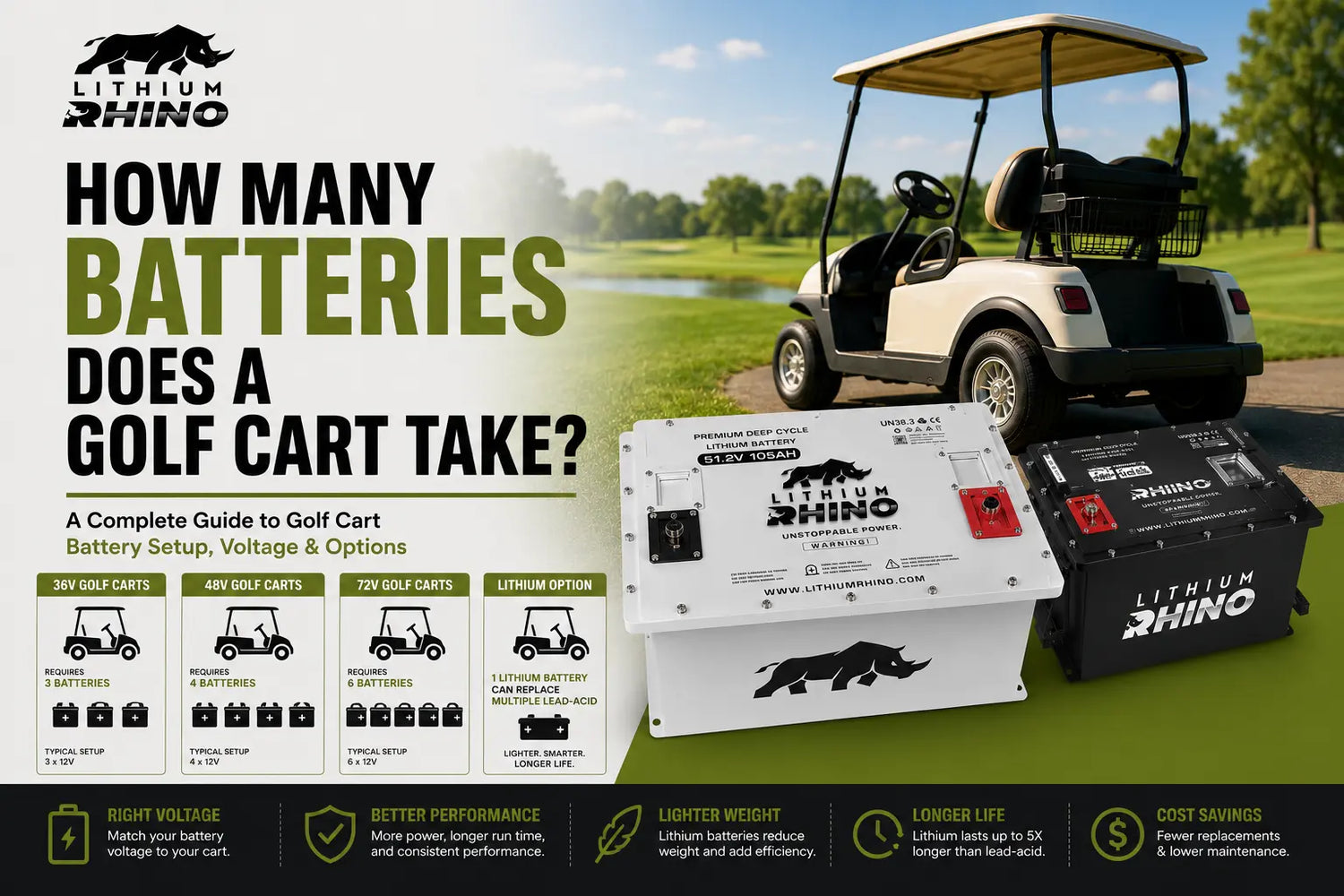
An EZGO golf cart takes 4 to 6 batteries depending on the model and voltage system. A 36V EZGO uses six 6-volt batteries. A 48V EZGO TXT or Express uses six 8-volt batteries. A 48V EZGO RXV uses four 12-volt batteries. Gas-powered EZGO carts use a single 12V starter battery. Modern lithium conversion kits replace the entire bank with a single LiFePO4 battery pack.
EZGO Battery Configuration at a Glance
| EZGO Model | System Voltage | Lead-Acid Battery Count | Individual Battery Voltage | Lithium Replacement |
|---|---|---|---|---|
| TXT (pre-2014) | 36V | 6 batteries | 6V each | 1 × 36V lithium pack |
| TXT (2014+) | 48V | 6 batteries | 8V each | 1 × 48V lithium pack |
| RXV (2008+) | 48V | 4 batteries | 12V each | 1 × 48V lithium pack |
| Freedom RXV | 48V | 4 batteries | 12V each | 1 × 48V lithium pack |
| Express S2 / S4 / S6 / L6 | 48V | 6 batteries | 8V each | 1 × 48V lithium pack |
| Medalist / Marathon | 36V | 6 batteries | 6V each | 1 × 36V lithium pack |
| ELiTE (factory lithium) | 48V | 1 lithium pack | N/A | Gen2 upgrade available |
| Gas-powered EZGO | 12V | 1 starter battery | 12V | Not applicable |
How Many Batteries Does an EZGO Golf Cart Take?
The number of batteries in your EZGO depends on two things: the total system voltage of your cart (36V, 48V, or gas) and the voltage rating of each individual battery (6V, 8V, or 12V). EZGO has produced both 36V and 48V electric models, plus gas-powered carts with a single starter battery, since the 1970s.
Here is the math behind every configuration:
- 6 × 6V batteries = 36V system (six six-volt batteries wired in series)
- 6 × 8V batteries = 48V system (six eight-volt batteries wired in series)
- 4 × 12V batteries = 48V system (four twelve-volt batteries wired in series)
- 1 × 12V starter = gas-powered cart
- 1 × lithium pack = the modern drop-in replacement for any of the above
Every battery in an electric EZGO is wired in series, meaning the voltage of each individual battery adds up to the total system voltage. The amp-hour (Ah) capacity stays the same as a single battery — it does not multiply. This is why simply adding more lead-acid batteries does not extend your range; you have to increase capacity per battery, or switch to lithium.
EZGO Battery Configuration by Model and Year
EZGO TXT (Pre-2014, 36V System)
Older EZGO TXT carts, most production from the 1990s through the early 2010s, use a 36-volt system powered by six 6-volt deep-cycle batteries wired in series. The OEM standard has been the Trojan T-105 (6V flooded lead-acid), with Duracell GC2 and US Battery US-2200 as common alternatives. These fleet workhorses are still in heavy daily use on courses, ranches, and resorts across the country.
EZGO TXT (2014–Present, 48V System)
Starting around the 2014 model year, EZGO transitioned most TXT production to a 48-volt system using six 8-volt deep-cycle batteries. The Trojan T-875 is the factory choice, with Duracell GC8 and US Battery US 8VGCXC as drop-in equivalents. The 48V upgrade delivers noticeably stronger torque on hills, better acceleration, and longer per-charge range than the older 36V layout.
EZGO RXV (2008–Present, 48V System)
The RXV launched in 2008 as EZGO's answer to the Club Car Precedent. Every RXV ever produced is a 48-volt cart powered by four 12-volt deep-cycle batteries. The four-battery layout sits lower in the chassis and uses a thinner battery tray than the six-battery TXT setup. Popular lead-acid replacements include the Trojan T-1275 (12V flooded) and AGM equivalents like the Duracell EGC12V.
EZGO Express (S2, S4, S6, L6 - 48V System)
The Express line, including the 2-passenger S2, 4-passenger S4, 6-passenger S6, and 6-passenger lifted L6, all run 48V systems with six 8-volt batteries, matching the modern TXT configuration. Larger Express models work the batteries harder due to extra passenger weight and cargo loads, which is why they're prime candidates for a lithium conversion that holds voltage steady under heavy load.
EZGO Freedom RXV (48V System)
The Freedom RXV is the consumer-trim version of the RXV platform, sold for personal and neighborhood use. It uses the same 48V / four 12-volt battery layout as the fleet RXV, though later production years switched to a stronger metal battery tray for improved durability.
EZGO Medalist and Marathon (Older 36V Systems)
Both the Medalist and Marathon are older 36V EZGO carts from the 1980s and 1990s, using six 6-volt batteries in series. A surprising number remain in active use today. If you own one and you're battling weak performance, a lithium conversion can give an older cart a complete second life with modern range and zero maintenance.
EZGO ELiTE (Factory Lithium, 2017–Present)
Since 2017, EZGO has offered factory-installed Samsung ELiTE™ lithium packs in select TXT, RXV, Express, and Freedom models. These carts use a single lithium battery pack instead of multiple lead-acid batteries. If your Gen1 Samsung ELiTE pack is failing, the Gen2 upgrade is available — or you can switch to a higher-capacity aftermarket LiFePO4 conversion for more range than the factory unit offered.
Gas-Powered EZGO Golf Carts
Gas EZGO models, the Workhorse, ST series, and gas-powered TXT, do not have a deep-cycle battery bank at all. They use a single 12-volt automotive-style starter battery, just like a car. No conversion kit is needed (or possible) for a gas cart.
How to Tell If Your EZGO Is 36V or 48V (4-Step Method)
Don't have your owner's manual? Use this four-step method to identify your EZGO's system voltage in under two minutes.
- Lift the seat to expose the battery compartment.
- Count the batteries. Six batteries usually means a 36V or 48V system. Four batteries means 48V (with 12V batteries). One battery means it's a gas cart.
-
Count the filler caps on a single battery. Each cap covers one 2-volt cell:
- 3 caps = 6V battery
- 4 caps = 8V battery
- 6 caps = 12V battery
- Multiply individual battery voltage × total number of batteries to confirm system voltage.
Worked examples:
- 6 batteries × 6V each (3 caps) = 36V system
- 6 batteries × 8V each (4 caps) = 48V system
- 4 batteries × 12V each (6 caps) = 48V system
If your batteries are sealed AGM or lithium (no filler caps), check the voltage label printed on the battery itself, then multiply by total count. You can also verify with a digital multimeter set to DC voltage across the main positive and negative terminals of the battery pack.
What Kind of Batteries Does an EZGO Golf Cart Use?
EZGO carts have historically used four battery chemistries. Knowing the difference matters because each has dramatically different lifespan and total cost of ownership.
Flooded Lead-Acid (FLA): the OEM standard for decades. Affordable upfront, but requires monthly watering, terminal cleaning, and equalization charging. Lifespan: 3–5 years with diligent maintenance, less if neglected.
Absorbed Glass Mat (AGM): sealed lead-acid that does not need watering. More expensive than flooded, lower maintenance. Lifespan: 4–6 years.
Gel Cell: similar to AGM, sealed and maintenance-free, but more sensitive to charging profiles. Less common today.
Lithium Iron Phosphate (LiFePO4): the modern upgrade. Lasts 8–12+ years, charges 2–3× faster, weighs 60–70% less than equivalent lead-acid, and requires zero maintenance.
For a chemistry-by-chemistry deep dive on why lithium has taken over the golf cart industry, see Why Choose Lithium? Top Benefits of Golf Cart Lithium Batteries.
How Much Does It Cost to Replace EZGO Golf Cart Batteries?
| Battery Type | Replacement Cost (parts + install) | Lifespan | Cost Per Year |
|---|---|---|---|
| Flooded lead-acid | $700 – $1,200 | 3–5 years | $200 – $400 |
| AGM lead-acid | $1,000 – $1,800 | 4–6 years | $200 – $350 |
| Lithium (LiFePO4) drop-in kit | $1,299 – $3,499 | 8–12+ years | $130 – $300 |
Lithium has the highest upfront cost but the lowest total cost of ownership over a 10-year window, especially once you factor in the two or three lead-acid replacement cycles you would otherwise pay for over that same period. Add in zero maintenance hours and zero corrosion damage to cables, brackets, and your cart's frame, and lithium wins on every long-term metric.
Why a Single Lithium Battery Replaces 4–6 Lead-Acid Batteries
Here is the part most EZGO owners do not realize: a single 48V lithium battery pack replaces your entire bank of 4 or 6 lead-acid batteries. One battery. One cable harness. One charger. That is it.
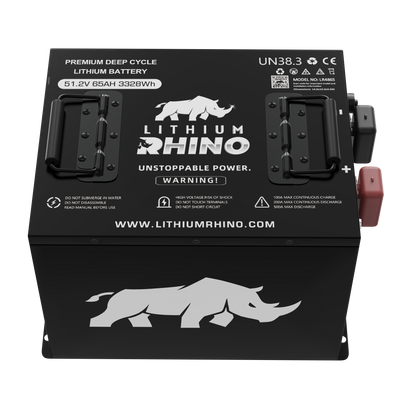
The reason this works comes down to chemistry and packaging. Lead-acid batteries are bulky and voltage-limited per unit, which is why manufacturers wire 4 to 6 of them in series to reach 36V or 48V. A modern LiFePO4 pack from Lithium Rhino delivers the full 48V (or 36V) from a single enclosure, with onboard Battery Management System (BMS), cell balancing, temperature protection, short-circuit protection, and overcharge protection all built in.
What you gain by switching:
- Massive weight savings. A six-battery 48V lead-acid bank weighs roughly 360 pounds. A 48V Lithium Rhino pack weighs about 100 pounds. That is 260 pounds of dead weight removed from your cart.
- 30–50% more range per charge thanks to deeper usable capacity and a flat voltage discharge curve.
- 6,000+ charge cycles, compared with 300–500 cycles for typical lead-acid.
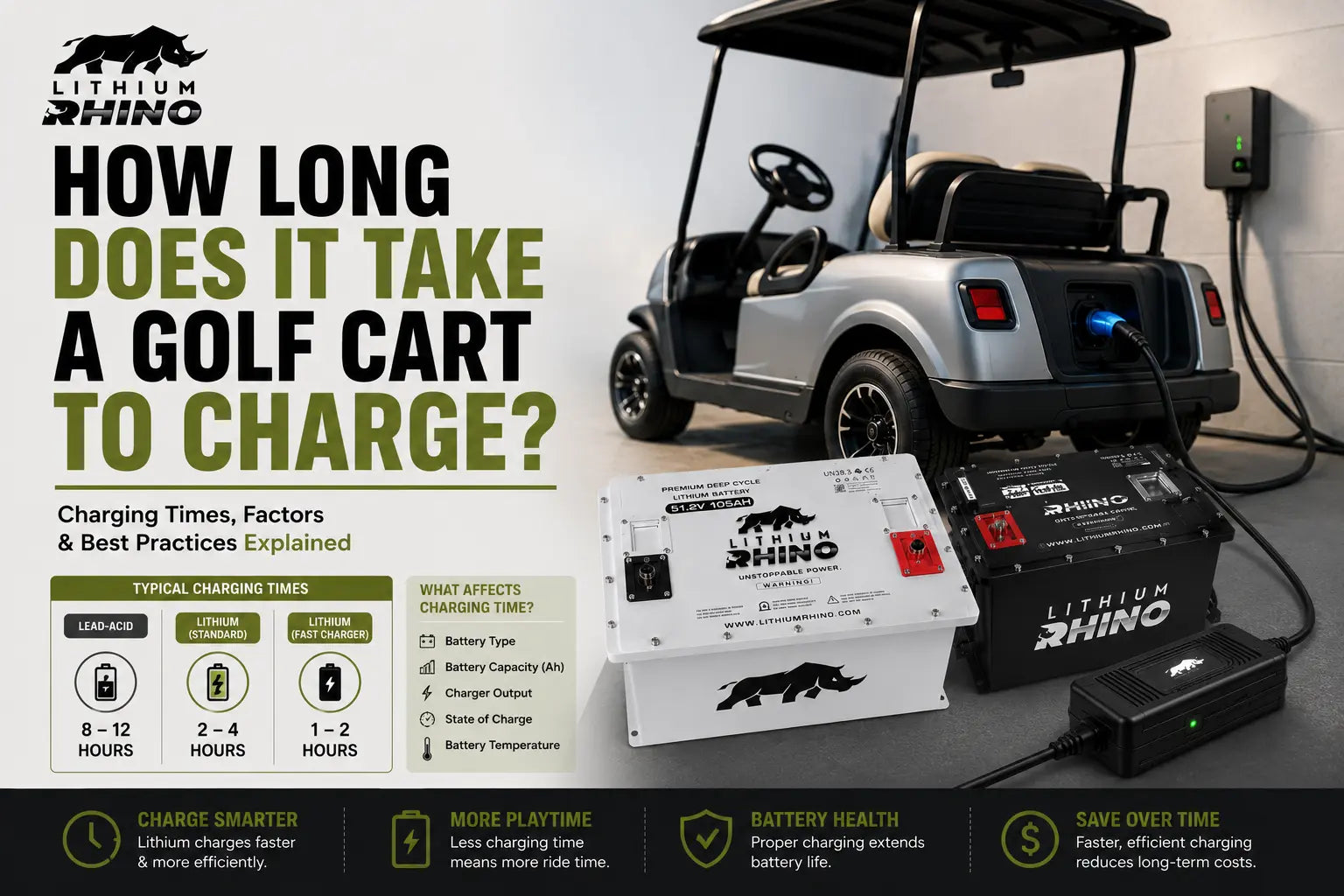
- 3–5 hour charging, compared with 8–12 hours for lead-acid.
- Zero maintenance. No watering. No terminal corrosion. No equalization charges. No corroded brackets eating your cart frame.
- 8-year full-coverage warranty with every Lithium Rhino conversion kit.
Choosing the Right Lithium Conversion Kit for Your EZGO
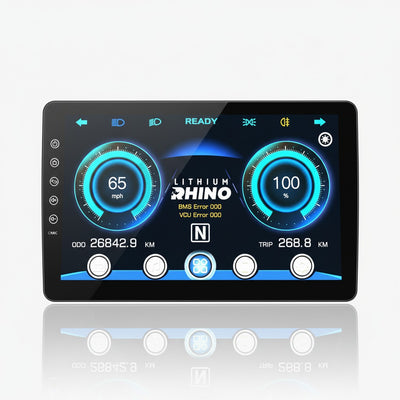
Lithium Rhino makes a drop-in conversion kit for every electric EZGO configuration. Each kit ships in a single box with everything needed for installation in one afternoon: the battery, an ultra-fast lithium charger, mounting brackets, main cables, 12V isolated reducer, LCD touchscreen with power button, lead-acid removal gear, safety equipment, and all hardware.
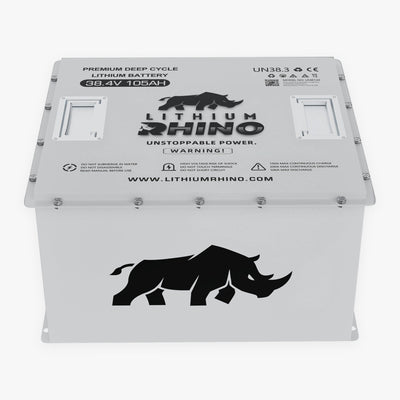
- For 36V EZGO TXT, Medalist, and Marathon: the 36V 105Ah Lithium Rhino Conversion Kit is the direct drop-in for six 6V lead-acid batteries.
- For 48V EZGO TXT (2014 and newer): choose the 48V 105Ah Lithium Rhino Conversion Kit for everyday range, or the 48V 120Ah kit for extended-range applications.
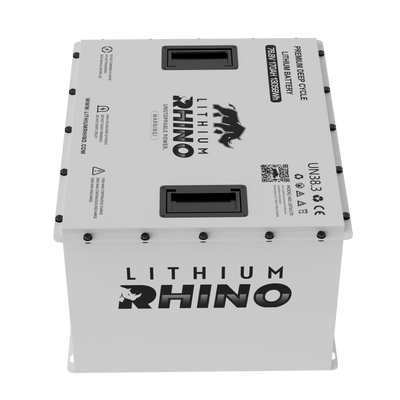
- For 48V EZGO RXV, Express, and Freedom: the compact 48V 105Ah CUBE fits tight RXV trays, or step up to the 48V 170Ah kit with 300A BMS for the longest possible range on lifted or heavily loaded carts.
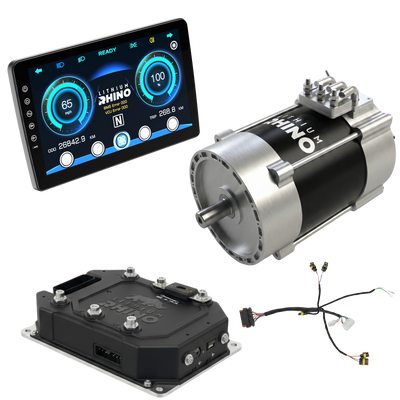
- For EZGO TXT carts with AC drive systems: the purpose-built Lithium Rhino EZ-Go TXT AC Conversion Kit is engineered specifically for AC controllers and motors.
Every Lithium Rhino kit is designed and engineered in Charlotte, North Carolina, ships with US-based support, an 8-year warranty, and a 30-day money-back guarantee.
Not sure which kit fits your specific cart? Take the 30-second battery quiz and we'll match you to the right voltage and capacity for your exact year, make, and model.
Frequently Asked Questions
How many batteries does an EZGO TXT take?
Pre-2014 EZGO TXT carts use six 6-volt batteries for a 36V total system. 2014 and newer TXT models use six 8-volt batteries for a 48V total system. Both layouts can be replaced by a single Lithium Rhino conversion kit matched to your cart's voltage.
How many batteries does an EZGO RXV take?
Every EZGO RXV uses four 12-volt deep-cycle batteries wired in series to create a 48V system. The newer Freedom RXV uses the same four-battery 12V layout.
How many batteries does an EZGO Express take?
The EZGO Express S2, S4, S6, and L6 all use six 8-volt batteries to make a 48V system, just like the modern TXT.
Are EZGO golf cart batteries 6V, 8V, or 12V?
It depends on the model and year. 36V EZGOs use 6V batteries. Most 48V EZGOs (TXT 2014+, Express, Freedom S models) use 8V batteries. The EZGO RXV uses 12V batteries. Check the cell-cap count on a single battery to confirm: 3 caps = 6V, 4 caps = 8V, 6 caps = 12V.
How long do EZGO golf cart batteries last?
Flooded lead-acid batteries last 3 to 5 years in an EZGO with regular use and proper maintenance. AGM lead-acid batteries last 4 to 6 years. Lithium LiFePO4 conversion kits last 8 to 12+ years and ship with multi-year full-coverage warranties.
How much does it cost to replace EZGO golf cart batteries?
Lead-acid replacement costs run $700 to $1,500 depending on configuration and battery quality. A drop-in lithium conversion runs $1,299 to $3,499 depending on capacity and voltage, but lasts two to three times longer with zero maintenance.
Can I put lithium batteries in my EZGO?
Yes. EZGO TXT, RXV, Express, Freedom, Medalist, and Marathon carts all accept drop-in LiFePO4 conversion kits. Most installations take an afternoon. EZGO began offering factory lithium (Samsung ELiTE) in 2017, but aftermarket kits like Lithium Rhino typically offer higher capacity, longer warranties, and stronger US-based support than the OEM options.
Do I need to change my charger when converting to lithium?
Yes. Lead-acid chargers use a charging profile that will damage a lithium pack over time. Every Lithium Rhino conversion kit includes a matched ultra-fast lithium charger in the box — no extra purchase needed.
Will lithium void my EZGO factory warranty?
If your EZGO is still under factory warranty, a lithium conversion may affect coverage on related electrical components. For the majority of owners with carts past the 1-year factory warranty window, lithium is the obvious upgrade. Every Lithium Rhino kit ships with its own 8-year full-coverage warranty that picks up where any factory coverage ends.
How long does it take to install a lithium conversion kit?
Most EZGO owners complete the installation in 3 to 5 hours using basic hand tools. Every kit ships with step-by-step instructions, and Lithium Rhino offers a free 30-minute video call with a US-based technician if you get stuck mid-install.
Ready to Ditch Lead-Acid for Good?
Stop replacing batteries every 3 years. Stop watering cells, scrubbing corrosion, and lifting 360 pounds of lead. One Lithium Rhino kit replaces your entire bank, drops 260 pounds, doubles your range, and lasts a decade.
👉 Take the 30-Second Quiz to find the perfect Rhino for your EZGO 👉 Shop All Lithium Conversion Kits — 8-year warranty, free shipping, 30-day guarantee

Leave a comment
This site is protected by hCaptcha and the hCaptcha Privacy Policy and Terms of Service apply.