

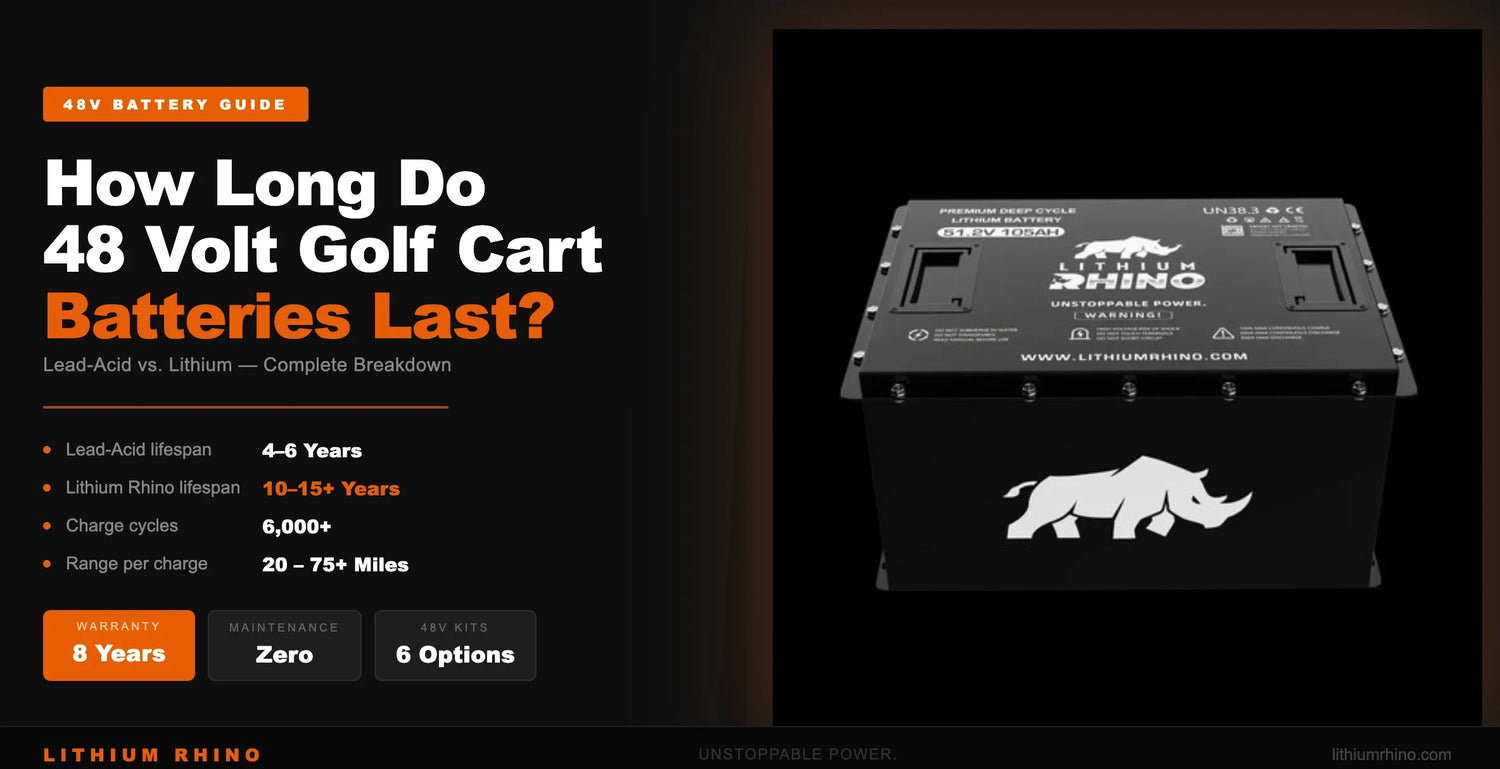
A 48V lead-acid battery pack typically lasts 4 to 6 years. A 48V lithium battery like the ones from Lithium Rhino lasts 10 to 15 years or longer, thanks to a 6,000+ charge cycle life. If you own a 48-volt golf cart — whether it's an EZ-GO, Club Car, Yamaha, or ICON you already know the 48V system is the gold standard for performance and range. But at some point, every cart owner asks the same question.
But the real story is what happens between day one and replacement day the performance decline, the warning signs, the costly mistakes, and the smarter choice most 48V cart owners are switching to in 2025.
Why 48 Volt? Understanding the Most Popular Golf Cart System
Before diving into lifespan, it's worth understanding why 48V is the dominant system on the market today.
Most modern golf carts and virtually all carts built in the last decade run on a 48-volt electrical system. Compared to older 36V systems, 48V carts deliver more torque, better hill-climbing ability, higher top speeds, and greater range per charge. Brands like EZ-GO TXT, Club Car Precedent, Yamaha Drive2, and ICON all use 48V as their standard configuration.
With a 48V lead-acid setup, you're typically running four 12V batteries, six 8V batteries, or eight 6V batteries wired in series to reach 48 volts total. That's a lot of individual batteries to maintain, monitor, and eventually replace.
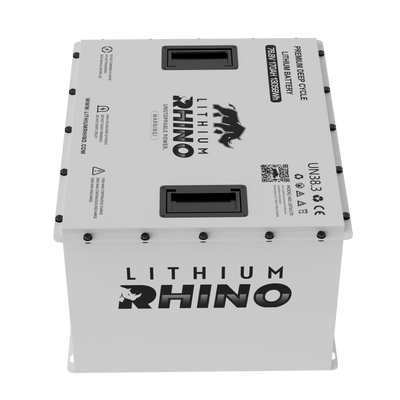
A 48V lithium conversion like Lithium Rhino's drop-in kits replaces that entire bank with a single, intelligent battery unit. One battery. Zero water fills. One charger. And a lifespan that outperforms the lead-acid pack by a factor of two to three.
How Long Do 48 Volt Golf Cart Batteries Last? By Battery Type
The answer depends entirely on the chemistry inside your battery. Here's how the three main 48V battery types compare:
48V Flooded Lead-Acid - 4 to 6 Years
This is what most 48V carts come with from the factory. Flooded lead-acid batteries are affordable upfront but demand consistent maintenance. You need to check and refill water levels monthly, clean terminals, equalize the pack periodically, and keep them on a proper charge schedule.
With excellent maintenance, 5 to 6 years is achievable. With average maintenance — which is how most people actually care for their batteries expect 3 to 4 years before noticeable performance decline sets in.
48V AGM (Sealed Lead-Acid) - 4 to 7 Years
AGM batteries are a sealed, maintenance-free version of lead-acid. They're more forgiving, less prone to spilling, and handle irregular use better than flooded batteries. However, they're still lead-acid at their core — they suffer the same voltage sag as charge depletes, the same sensitivity to deep discharges, and a similar overall lifespan ceiling.
48V Lithium Iron Phosphate (LiFePO4) - 10 to 15+ Years
This is the category that's changing the game. LiFePO4 chemistry delivers a dramatically longer cycle life, consistent voltage output from full to nearly empty, and zero maintenance requirements.
Lithium Rhino's 48V batteries are rated for 6,000+ charge cycles. At one charge cycle per day, that's over 16 years of daily use. Even at two cycles per day for heavy commercial use, you're looking at 8+ years — still well beyond what any lead-acid pack will deliver.
48V Golf Cart Battery Lifespan Comparison Table
| Battery Type | Configuration | Avg. Lifespan | Charge Cycles | Maintenance |
|---|---|---|---|---|
| Flooded Lead-Acid | 4×12V / 6×8V / 8×6V | 4–6 years | 500–1,000 | Monthly |
| AGM Sealed | 4×12V / 6×8V | 4–7 years | 500–1,200 | Minimal |
| Lithium (LiFePO4) | Single unit | 10–15+ years | 6,000+ | None |
One critical thing most people don't realize about lead-acid: capacity degrades from day one. By year two or three, your 48V pack is already delivering noticeably less range per charge even if it hasn't "died" yet. Lithium holds its capacity flat for most of its life, then gradually tapers near end of cycle life.
What Affects How Long Your 48V Golf Cart Battery Lasts?
Even the best battery can underperform if the conditions aren't right. These are the factors that matter most:
Charging Habits
This is the single biggest variable in 48V battery lifespan especially for lead-acid.
- Always charge your 48V lead-acid pack after every use, even short rides. Leaving lead-acid batteries in a partially discharged state causes sulfation, a buildup of lead sulfate crystals on the battery plates that permanently destroys capacity. This is the number one killer of 48V lead-acid packs.
- Never overcharge lead-acid batteries. Without a smart charger that automatically shuts off at full charge, overcharging is easy to do and causes overheating and plate damage.
- 48V lithium batteries are far more forgiving. Lithium Rhino's batteries come with an intelligent Battery Management System (BMS) that handles overcharge protection, over-discharge protection, and thermal management automatically. The included 25-amp smart charger shuts off automatically at full charge no babysitting needed.
Depth of Discharge (DoD)
With lead-acid, regularly discharging below 50% dramatically shortens battery life. Each deep discharge cycle causes measurable plate degradation, and the cumulative effect is a battery that reaches end-of-life much sooner than its rated cycle count.
Lithium Iron Phosphate handles deep discharges far better. Most LiFePO4 batteries are rated to 80–90% depth of discharge without meaningful capacity loss. That means more of your rated amp-hours are actually usable and less wear per cycle.
Temperature and Storage
Cold winters and hot summers both affect 48V battery performance, but the impact on lead-acid is far more severe.
- Lead-acid batteries lose significant capacity in cold temperatures and can freeze solid if stored discharged.
- They self-discharge at 15–30% per month during storage, meaning you need to recharge them every 30–45 days during off-season storage to prevent permanent damage.
- Lithium Rhino batteries self-discharge at just 2–3% per month, making long storage periods far less stressful.
For golf cart owners in cold climates, Lithium Rhino offers self-heated 48V models that automatically warm the battery cells to 32°F before charging begins protecting cell integrity year-round.
Number of Batteries in Your 48V Pack
Here's something specific to lead-acid 48V systems: if one battery in your pack dies early, it drags down the entire pack. Because lead-acid batteries are wired in series, a weak cell in any single battery causes uneven charging across the whole bank, accelerating deterioration in every other battery.
This is why most experts recommend replacing your full 48V lead-acid pack at once — not just the one that's failing. That's another hidden cost of lead-acid that adds up over time.
With a single 48V lithium battery unit from Lithium Rhino, this problem doesn't exist. There's one battery to monitor, one unit to replace, and no chain reaction of degradation.
Usage Intensity
Running your 48V cart hard — steep hills, heavy loads, frequent long trips, fleet use — puts more demand on the battery and produces more heat. For lead-acid, this accelerates wear noticeably. For lithium, the intelligent BMS continuously adapts to demanding conditions, protecting the cells while still delivering full power.
Lithium Rhino's 48V batteries handle 200A continuous discharge current and up to 500A peak discharge for 30 seconds built for real-world use, not just leisurely cruising.
How Far Will a 48V Golf Cart Battery Go on a Single Charge?
Range is just as important as lifespan and the gap between lead-acid and lithium is significant.
| Battery | Range Per Charge | Performance as Charge Drops |
|---|---|---|
| 48V Lead-Acid | 15–25 miles | Slows noticeably below 50% |
| 48V Lithium Rhino 50Ah | 20+ miles | Full power to ~20% charge |
| 48V Lithium Rhino 65Ah | 27+ miles | Full power to ~20% charge |
| 48V Lithium Rhino 105Ah | 50+ miles | Full power to ~20% charge |
| 48V Lithium Rhino 105Ah 'CUBE' | 50+ miles | Full power to ~20% charge |
| 48V Lithium Rhino 120Ah | 60+ miles | Full power to ~20% charge |
| 48V Lithium Rhino 170Ah | 75+ miles | Full power to ~20% charge |
The range difference is significant but the performance consistency difference is what most people notice day to day. Lead-acid voltage sags as charge depletes, meaning your cart gets progressively slower as the day wears on. Lithium delivers the same voltage and the same speed from 100% charge all the way down to about 20%.
As one Lithium Rhino customer described it after switching: "Twice the power of lead-acid and a constant output regardless of your battery life full speed ahead whether you are at 100% or 30% charge."
Signs Your 48V Golf Cart Battery Is Dying
Don't wait for a complete breakdown. These are the warning signs that your 48V battery pack needs replacement:
1. Dramatically reduced range per charge Your cart used to handle 18 holes easily. Now it's struggling at 9. This is the earliest and most consistent indicator of a battery pack that's lost significant capacity.
2. Sluggish acceleration and slower top speed If your cart hesitates from a stop or feels slower than it used to — especially going uphill the batteries are losing their ability to deliver adequate current.
3. Speed drops significantly as battery level decreases This is the lead-acid voltage sag effect. If your cart performs normally at full charge but noticeably slows down at 60%, 50%, or 40% charge, the batteries are degrading.
4. Batteries stay warm long after charging ends Healthy batteries cool down relatively quickly after a charging session. Batteries that remain warm for extended periods are working harder than they should — a sign of internal resistance increasing with age.
5. Charging takes significantly longer than it used to Aging batteries take longer to accept a full charge. If 8-hour charging sessions have crept to 12+ hours, your pack is on the decline.
6. Visible swelling, leaking, or severe terminal corrosion These are immediate safety concerns and replacement signals. A swollen or leaking battery should be removed and recycled right away.
7. Your batteries are 4+ years old Even without dramatic symptoms, lead-acid batteries over four years old are statistically near end of life. Testing them and planning for replacement is the smart proactive move.
How Often Should You Replace 48V Golf Cart Batteries?
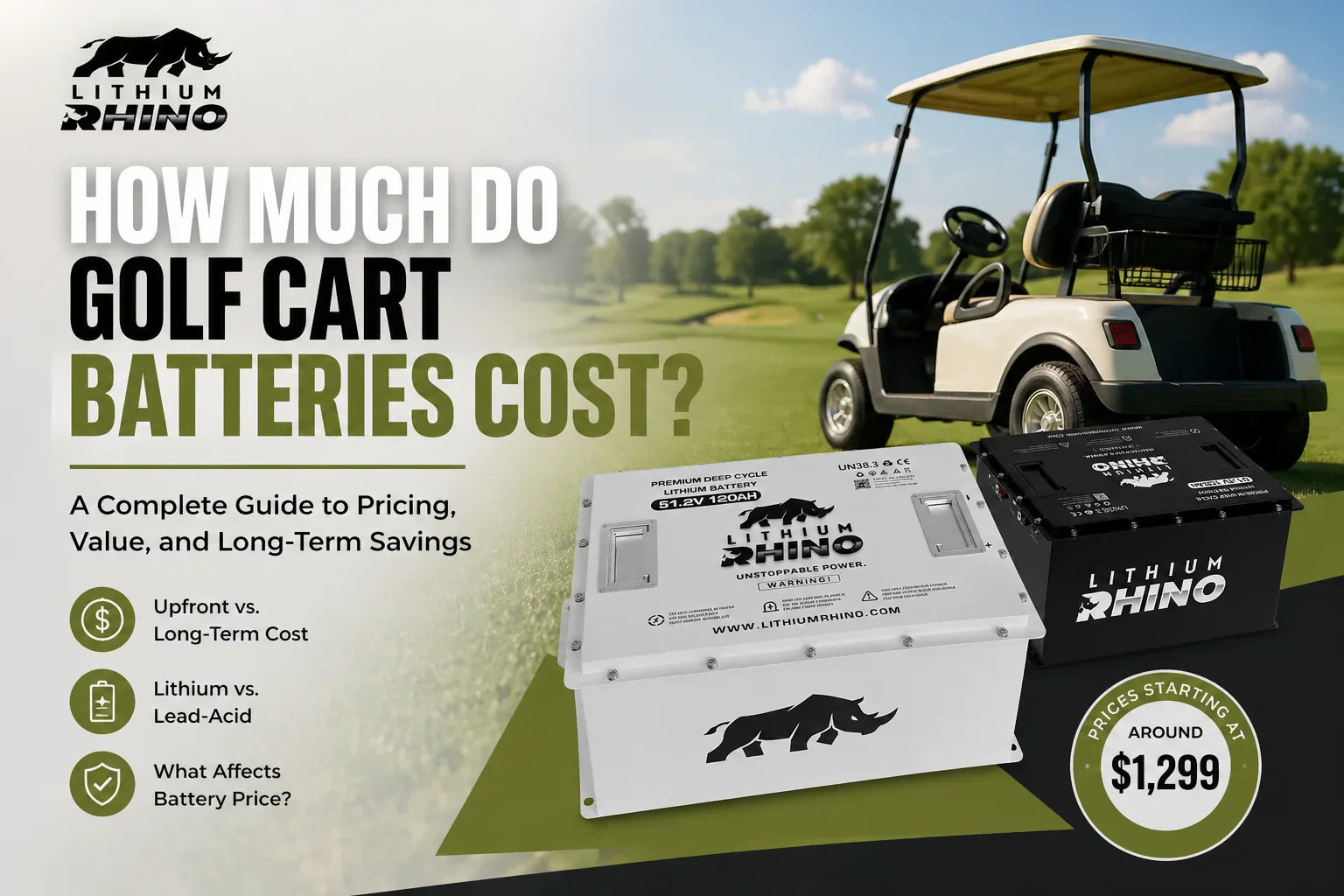
For 48V lead-acid packs, most golf cart owners replace them every 4 to 6 years and often sooner. The full replacement cost for a 48V lead-acid bank typically runs $800 to $1,500+, not counting the labor if you're not doing it yourself.
Over a 15-year ownership period, that's two or three full replacement cycles spending $2,400 to $4,500+ just on batteries, plus hundreds of hours of maintenance time.
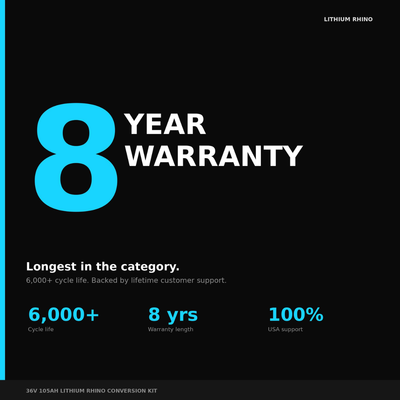
48V lithium batteries completely change this math. A Lithium Rhino conversion kit is a one-time investment backed by an 8-year warranty. After 10 years, your lithium battery is still delivering strong performance while a lead-acid owner would have already replaced their pack twice.
For a full comparison of golf cart battery lifespan by battery type, check out our complete guide: How Long Do Golf Cart Batteries Last?
How to Extend the Life of Your 48V Golf Cart Battery
Whether you're working with lead-acid right now or have already switched to lithium, these habits maximize your battery's useful life:
For 48V Lead-Acid Batteries:
- Charge immediately after every use — never leave discharged
- Check and refill cells with distilled water monthly
- Perform equalization charging every 30–60 days to balance cell voltages
- Keep terminals clean and lightly coated with terminal spray
- Store fully charged; recharge every 30–45 days during long storage
- Avoid discharging below 50% capacity
- Replace all batteries in the pack at the same time — never mix ages
For 48V Lithium Batteries (Lithium Rhino):
- Charge regularly using only the included or approved charger
- Connect via Bluetooth app to monitor battery health in real time
- Store in a cool, dry place — no recharge schedule needed during storage
- Let the BMS do its job — don't override or bypass it
- Register your warranty within 30 days of purchase for full coverage
48V Lead-Acid vs. 48V Lithium: The Real Cost of Ownership
| 48V Lead-Acid (15 Years) | 48V Lithium Rhino (15 Years) | |
|---|---|---|
| Battery replacements | 2–3 times | 0 — still going strong |
| Estimated battery cost | $2,400–$4,500+ | One-time investment |
| Maintenance time | Hours per month | Zero |
| Range per charge | 15–25 miles (declining) | 20–75+ miles (consistent) |
| Weight | 250–360+ lbs | 40–63 lbs |
| Charging time | 8–12 hours | 4 hours |
| Warranty | 1–2 years | 8 years |
The numbers tell a clear story. When you look past the upfront price and zoom out to total ownership cost over 10 to 15 years, 48V lithium wins by a wide margin.
Why Lithium Rhino Is the Best 48V Golf Cart Battery Upgrade
If you're ready to make the switch to a 48V lithium battery, Lithium Rhino offers the most complete, best-warranted conversion kits available designed specifically for real golf cart owners, not engineers.
Available 48V Lithium Rhino Kits:
- 48V 50Ah Rhino Kit — 20+ mile range, drop-in ready, same footprint as a single lead-acid battery — ideal for stock neighborhood carts
- 48V 65Ah Rhino Kit — 27+ mile range, fits virtually every 48V cart with zero modification, perfect for 36-hole riders
- 48V 105Ah Rhino Kit — 50+ mile range, our most popular all-round kit for serious and frequent riders
- 48V 105Ah 'CUBE' Rhino Kit — same 50+ mile power in a compact cube form factor, built for tighter battery compartments
- 48V 120Ah Rhino Kit — 60+ mile range with self-heated charging technology, the ultimate choice for cold-climate, all-season use
- 48V 170Ah Rhino Kit — maximum range and power for the most demanding riders, heavy loads, and extended-use applications
Every Lithium Rhino 48V kit includes:
- Intelligent BMS with Bluetooth app monitoring
- Ultra-fast smart charger (auto shuts off at full charge)
- LCD touch screen battery monitor
- All hardware, wiring, and mounting brackets
- Step-by-step instructions + installation video
- Free 30-minute video call with a certified tech
- 8-year warranty — 6 years full coverage, final 2 years with $500 service option
Compatible with EZ-GO TXT, Club Car Precedent, Yamaha Drive/Drive2, ICON, and most other 48V platforms.
Frequently Asked Questions
How long does a 48V golf cart battery last on a single charge?
With a Lithium Rhino 48V battery, expect 20 to 75+ miles per charge depending on the model — from the compact 50Ah all the way up to the 170Ah powerhouse. Lead-acid packs typically deliver 15 to 25 miles, and that range shrinks year after year as the pack ages.
How many batteries are in a 48V golf cart?
Lead-acid 48V setups use multiple batteries wired in series typically four 12V, six 8V, or eight 6V batteries. A Lithium Rhino conversion replaces that entire bank with one single 48V battery unit.
Can I replace just one bad battery in my 48V lead-acid pack?
Not recommended. Mixing batteries of different ages causes uneven charging across the pack and accelerates degradation in the newer batteries. Always replace the full 48V bank at once.
How do I know when my 48V golf cart battery needs replacing?
The biggest signs are reduced range per charge, sluggish acceleration, noticeable speed drop as charge decreases, and slow or incomplete charging. Batteries over 4 years old showing any of these symptoms should be tested and likely replaced.
Is a 48V lithium conversion worth it?
For most 48V golf cart owners planning to keep their cart for 5+ years, yes the math strongly favors lithium. You eliminate recurring replacement costs, all maintenance, and gain significantly better performance and range in the process.
How long does a 48V lithium golf cart battery take to charge?
Lithium Rhino's 48V batteries charge fully in approximately 4 hours with the included smart charger versus 8 to 12 hours for lead-acid.
Does a 48V lithium battery work in cold weather?
Standard lithium batteries perform well in temperatures above freezing. Lithium Rhino's self-heated 120Ah model warms the cells before charging begins, making it a true all-season solution for cold climates.
The Bottom Line
So how long do 48 volt golf cart batteries last?
- 48V lead-acid: 4 to 6 years, declining performance from the start, monthly maintenance required
- 48V lithium (Lithium Rhino): 10 to 15+ years, consistent performance throughout, zero maintenance
If your 48V pack is approaching 4 years old, slowing down, or just not delivering the range it once did — this is your sign. Don't spend another $1,000+ on a lead-acid replacement that puts you right back in the same cycle in four years.
Make the switch to Lithium Rhino and never buy another golf cart battery.
👉 Shop 48V Lithium Rhino Conversion Kits — find your cart, pick your range, and drive further than ever.


Leave a comment
This site is protected by hCaptcha and the hCaptcha Privacy Policy and Terms of Service apply.