


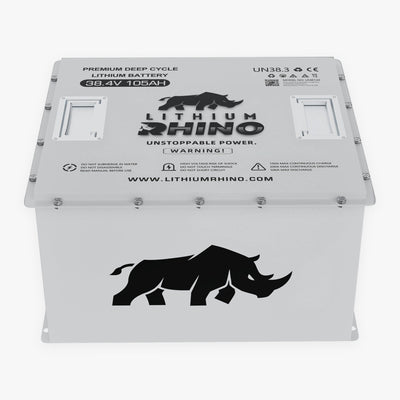
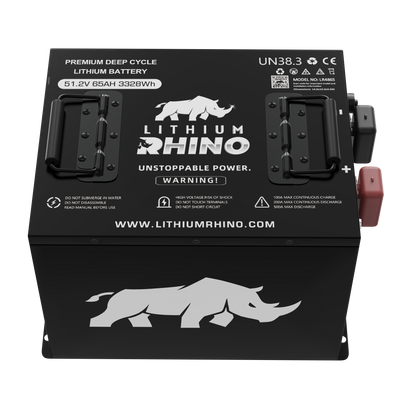
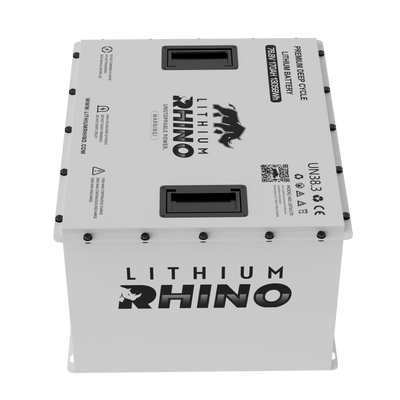
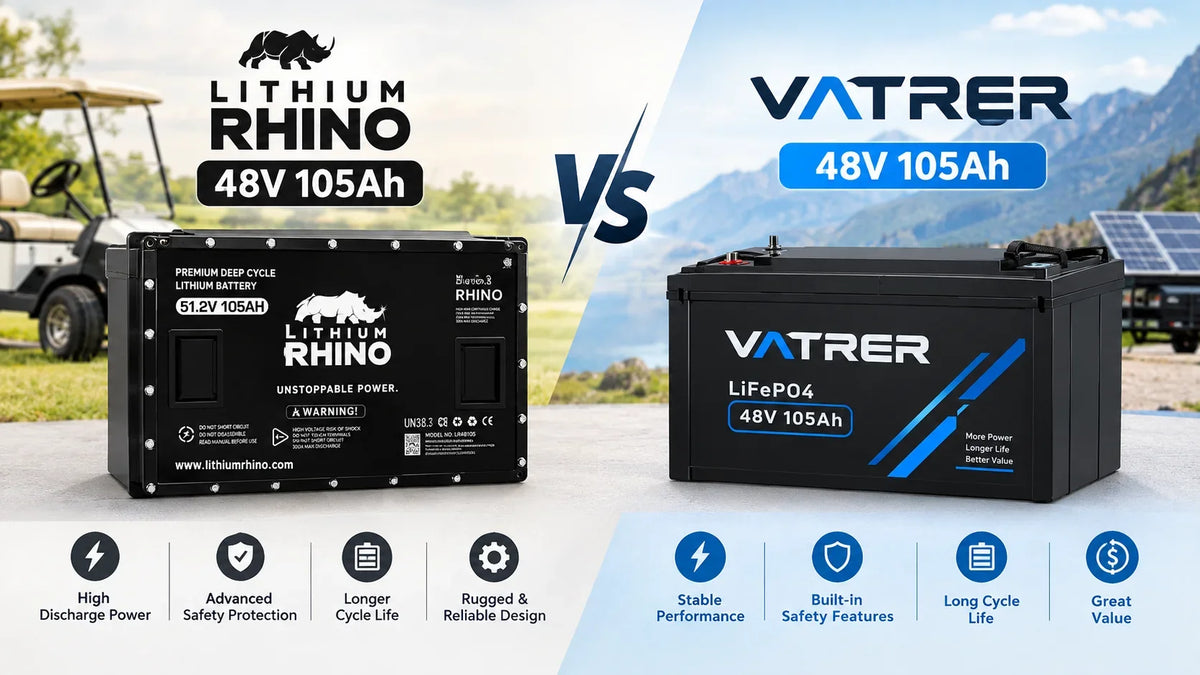
If you are comparing the Lithium Rhino 48V 105Ah and Vatrer 48V 105Ah lithium golf cart batteries, both offer 105Ah of capacity, 5,376Wh of energy and a 200A continuous discharge rating. The bigger differences are in cycle life, conversion-kit contents, warranty, installation support, physical design and overall ownership value.
For buyers looking for a complete golf cart conversion rather than simply the lowest-cost battery, the Lithium Rhino 48V 105Ah Conversion Kit offers a particularly strong combination of 6,000+ rated cycles, a complete installation package, Bluetooth monitoring, a 25A charger, 40A DC converter and an 8-year warranty.
Vatrer is still a legitimate alternative. Its 48V 105Ah model has a 200A continuous discharge rating, 4,000+ cycle rating, IP67 protection and a slightly lower published weight.
So which one should you choose?
If your priority is the lowest upfront cost or IP67 water protection, Vatrer deserves consideration. If your priority is a complete conversion package, higher published cycle life, long-term support and a more comprehensive ownership package, Lithium Rhino is the stronger fit.
Lithium Rhino 48V 105Ah vs Vatrer 48V 105Ah at a Glance
| Feature | Lithium Rhino 48V 105Ah | Vatrer 48V 105Ah |
|---|---|---|
| Battery chemistry | LiFePO4 | LiFePO4 |
| Nominal voltage | 48V | 51.2V |
| Capacity | 105Ah | 105Ah |
| Energy | 5,376Wh | 5,376Wh |
| Continuous discharge | 200A | 200A |
| Published maximum/peak discharge | Up to 700A | 400A for 35 seconds |
| Rated cycle life | 6,000+ cycles | 4,000+ cycles |
| Bluetooth monitoring | Yes | Yes |
| LCD/display | Included | Included |
| Charger | 25A | 18A or 20A depending on configuration |
| DC converter | 40A included in Rhino conversion kit | Configuration dependent |
| IP rating | IP65 | IP67 |
| Weight | 105 lb | 102.5 lb |
| Warranty | 8 years | Check the specific Vatrer model's current warranty terms |
| Installation package | Complete conversion kit | Battery and model-specific accessories |
| Best suited to | Complete conversion and long-term ownership | Buyers prioritising price and IP67 protection |
The specifications above are based on the manufacturers' currently published product information. Vatrer's exact included accessories can vary by cart-specific configuration, so buyers should check the selected SKU before ordering.
Which 48V 105Ah Battery Is Better?
There isn't a meaningful difference in nominal capacity between these two batteries. Both are rated at 105Ah and 5,376Wh.
The more important question is what you get around the battery.
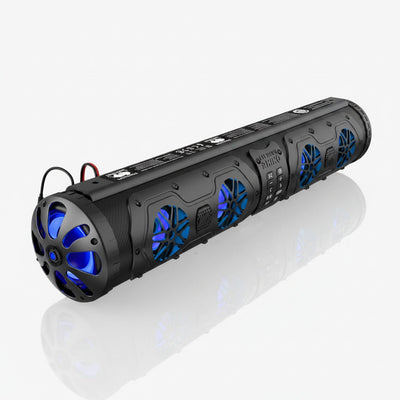
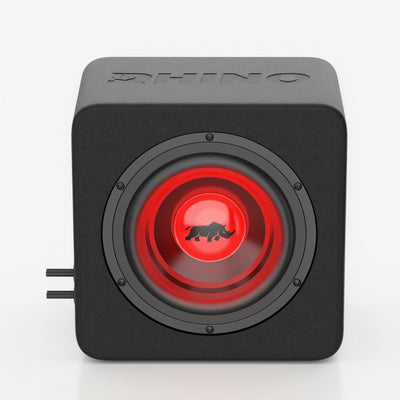
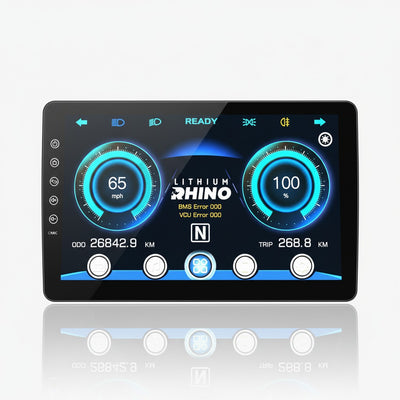
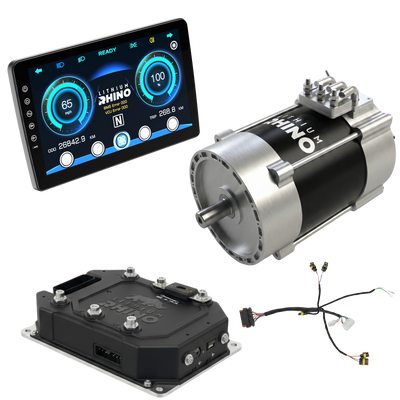
Lithium Rhino positions its 48V 105Ah as a complete conversion kit. The package includes the lithium battery, 25A charger, 40A DC converter, LCD touchscreen and mount, charge-port adapter, wiring, mounting hardware and other installation equipment.
Vatrer's 48V 105Ah package includes the battery, charger, LCD monitor, communication cables, terminals and manual, with the exact configuration depending on the cart and product variant.
That distinction matters because the cheapest battery price is not necessarily the cheapest complete conversion.
1. Capacity: Lithium Rhino and Vatrer Are Essentially Equal
Both batteries are rated at:
105Ah × 51.2V ≈ 5,376Wh
That means neither battery has a meaningful capacity advantage simply because it carries a 105Ah label.
Lithium Rhino lists 48V nominal voltage, 105Ah capacity and 5,376Wh total energy. Vatrer lists 51.2V nominal voltage, 105Ah capacity and the same 5,376Wh energy figure.
For buyers comparing these two batteries, capacity should therefore not be the deciding factor.
The more useful comparison is what each manufacturer provides in terms of BMS capability, charging, installation, monitoring, support and long-term ownership.
If you want to compare other Lithium Rhino capacities, you can browse the full range of Lithium Rhino golf cart conversion kits.
2. BMS and Discharge Power: Both Offer 200A Continuous Output
The battery management system is one of the most important parts of a lithium golf cart battery.
Lithium Rhino lists a 200A continuous discharge rating and up to 700A maximum discharge on its 48V 105Ah product page. The product page also describes 200A continuous and 500A peak output in its feature section, so buyers should treat the detailed specification and current product configuration as the authoritative reference for their particular battery.
Vatrer lists 200A maximum continuous discharge, with a published peak of 400A for 35 seconds on its 48V 105Ah Club Car configuration.
The important point is that continuous current and peak current are not the same thing.
A peak figure generally describes what the battery can provide for a limited period. Continuous current is more relevant when assessing sustained electrical demand from the motor and controller.
For a standard golf cart, both batteries provide a substantial 200A continuous rating.
For modified carts, performance controllers or applications where current demand matters more, the complete electrical system should be evaluated rather than choosing a battery based only on its biggest peak-current number.
What does this mean in real-world use?
For most stock carts, you are unlikely to need anything close to the maximum BMS output continuously.
However, a robust BMS gives the system more electrical headroom for situations such as:
- Hill climbing
- Carrying additional passengers
- Higher controller demand
- Larger tyres
- Modified golf carts
- Repeated acceleration
- Utility and off-road use
If your cart has a performance controller, check the controller's actual current requirements before ordering.
3. Cycle Life: Lithium Rhino Has the Higher Published Rating
This is one of the clearest specification differences.
Lithium Rhino rates its 48V 105Ah battery at 6,000+ charge cycles.
Vatrer lists 4,000+ cycles for its 48V 105Ah battery.
That does not mean either battery will suddenly stop working when it reaches its stated cycle number. Cycle-life figures are manufacturer ratings and depend on factors such as depth of discharge, charging conditions, temperature and usage.
But when comparing the manufacturers' published specifications directly, Lithium Rhino has the higher rated cycle life.
For a golf cart owner planning to keep the cart for many years, that is an important part of the ownership calculation.
4. Why Does Cycle Life Matter?
Suppose you use your golf cart regularly and cycle the battery frequently.
A higher rated cycle life can potentially mean a longer useful service period before battery degradation becomes a major concern.
That is why looking only at the purchase price can give an incomplete picture.
A better comparison is:
Purchase price + installation cost + charger + accessories + expected service life + warranty + support
This is particularly important when comparing a complete conversion kit against a battery-only product.
5. Charging: Lithium Rhino Includes a 25A Charger
Charging speed is another important difference.
The Lithium Rhino 48V 105Ah conversion kit includes a 25A smart charger and states a charging time of around four hours under its advertised conditions.
Vatrer's published 48V 105Ah Club Car configuration lists an 18A charger, while other Vatrer 105Ah configurations use a 20A charger.
This is worth checking before ordering because charger configuration can vary by Vatrer model.
A higher-current charger can reduce charging time when the battery and charging system are designed to support it.
For owners who use their golf cart frequently and want a shorter turnaround between rides, the charger supplied with the conversion kit matters.
6. Lithium Rhino Includes a 40A DC Converter
One commonly overlooked part of a golf cart lithium conversion is the DC converter.
A lithium battery changes the main energy-storage system, but your golf cart still needs a suitable 12V supply for accessories such as:
- Lights
- Horn
- USB accessories
- Gauges
- Stereo equipment
- Other 12V electronics
The Lithium Rhino 48V 105Ah conversion kit includes a 40A DC converter.
This is important when comparing the actual contents of a conversion kit rather than comparing battery prices alone.
If a competing battery requires you to purchase additional conversion hardware separately, the initial price difference can become much smaller once the complete installation is assembled.
7. Installation: This Is Where a Complete Kit Can Make a Difference
A battery can be inexpensive on paper but more expensive to install if you need to source additional parts.
Lithium Rhino's 48V 105Ah conversion kit includes:
- 48V 105Ah LiFePO4 battery
- 25A smart charger
- 40A DC converter
- LCD touchscreen and mount
- Charge-port adapter
- Heavy-gauge wiring
- Mounting brackets
- Hardware
- Lead-acid removal strap
- Safety equipment
- Bluetooth connectivity
The manufacturer describes the kit as a complete conversion package designed for a drop-in installation.
You can see the complete configuration on the Lithium Rhino 48V 105Ah Conversion Kit page.
Vatrer also offers conversion kits and model-specific accessories, but the exact contents depend on the selected configuration. Its published Club Car package, for example, includes the battery, charger, LCD monitor, communication cables, terminals and manual.
The practical takeaway
If you already have the required electrical hardware and are comfortable completing a DIY conversion, the difference may matter less.
If you want a complete conversion package with the major installation components supplied together, Lithium Rhino has a clear advantage in convenience.
8. Bluetooth Monitoring and LCD Displays
Both brands provide battery monitoring.
Lithium Rhino includes a Bluetooth module that connects to its mobile app, allowing users to monitor battery information from a phone. Its product page lists real-time state-of-charge, voltage and temperature information along with fault alerts and cycle history.
Vatrer's 48V 105Ah product also includes Bluetooth-related monitoring and an LCD display, depending on the configuration.
For most buyers, this is not a reason by itself to choose one battery over another.
The real value is being able to see battery status without guessing how much energy remains.
9. IP65 vs IP67: Vatrer Has the Higher Published IP Rating
This is an area where Vatrer has a clear specification advantage.
Lithium Rhino lists its 48V 105Ah battery as IP65 rated and splash proof.
Vatrer's 48V 105Ah product is listed as IP67.
IP67 provides a higher level of protection against water ingress than IP65 under the relevant test conditions.
That does not mean golf cart owners should deliberately expose either battery to water or pressure washing.
In fact, Lithium Rhino's warranty terms specifically exclude damage involving water submersion and pressure washing.
So if maximum published ingress protection is one of your top priorities, Vatrer's IP67 rating is worth considering.
But for buyers primarily concerned with battery life, conversion equipment, charging and long-term support, IP rating is only one part of the decision.
10. Weight and Size
Lithium Rhino lists its standard 48V 105Ah battery at:
105 lb
with dimensions of approximately:
18 × 13.1 × 9.3 inches.
Vatrer's 48V 105Ah Club Car battery is listed at:
102.5 lb
with dimensions of approximately:
19.69 × 12.52 × 9.6 inches.
So Vatrer is slightly lighter, while the physical dimensions differ in shape.
Fitment is more important than a few pounds of weight.
Always confirm your exact golf cart model, year and battery compartment dimensions before ordering.
Lithium Rhino also offers a 48V 105Ah CUBE configuration with a shorter physical footprint for certain fitment situations.
11. Range: Capacity Matters, But So Does How You Drive
Both batteries provide 5,376Wh of energy, so it would be misleading to promise that one will automatically deliver a dramatically longer range simply because of the brand name.
Actual golf cart range depends on:
- Terrain
- Vehicle weight
- Passenger load
- Tyre size
- Driving speed
- Controller settings
- Motor efficiency
- Temperature
- Driving style
- Accessory use
Lithium Rhino currently advertises 50–65 miles for its 48V 105Ah conversion kit, while the product description also states an extended drive range of 50 miles on a single charge.
Vatrer's published 48V 105Ah self-heating model states that it can support up to 50 miles on a charge depending on terrain and load.
These are manufacturer claims rather than a guarantee of identical real-world range for every cart.
For range, compare the battery's energy capacity first, then consider the rest of the cart.
12. Warranty and Long-Term Support
Warranty is one of the biggest reasons to look beyond the cheapest lithium battery.
Lithium Rhino provides an 8-year limited warranty on its LiFePO4 batteries. Its current warranty documentation states that registration is required within 120 days for the full warranty term. Registered batteries receive the stated coverage for the first 72 months, followed by prorated coverage through the remainder of the eight-year period.
The 48V 105Ah product page also states that the kit includes an 8-year warranty and lifetime customer support.
This is particularly relevant for a golf cart conversion because battery support is not only about replacing cells.
Questions can arise around:
- Cart compatibility
- Wiring
- Charger setup
- BMS behaviour
- Display configuration
- Installation
- Troubleshooting
- Warranty claims
A company providing support throughout ownership can be valuable when the battery is part of a complete vehicle conversion.
You can review the full Lithium Rhino warranty terms before purchasing.
13. Is Lithium Rhino Worth Paying More For?
This is probably the most important question for someone comparing these two batteries.
The answer depends on what you are actually buying.
If you only compare:
105Ah vs 105Ah
the batteries look very similar.
If you compare:
5,376Wh vs 5,376Wh
they are again essentially equal.
If you compare:
200A continuous vs 200A continuous
they are also equal on that headline specification.
But the comparison changes when you look at the complete package.
Lithium Rhino's published 48V 105Ah package includes a 25A charger, 40A DC converter, LCD touchscreen, mounting equipment, wiring, charge-port hardware and other installation components, along with the battery, Bluetooth monitoring and an 8-year warranty.
That makes the relevant question:
Am I buying the cheapest 105Ah battery, or am I buying a complete lithium conversion with long-term support?
For buyers who want a complete conversion solution, Lithium Rhino's package can justify the additional upfront investment.
14. Lithium Rhino 48V 105Ah vs Vatrer 48V 105Ah: Which Should You Buy?
Here's a practical way to look at the decision.
Choose Lithium Rhino if you want:
- A complete golf cart conversion kit
- 6,000+ published cycle life
- 200A continuous BMS output
- A published maximum discharge figure up to 700A
- 25A smart charger included
- 40A DC converter included
- LCD touchscreen
- Bluetooth monitoring
- Installation hardware supplied
- 8-year warranty
- Lifetime customer support
- A long-term ownership package rather than simply the lowest battery price
Consider Vatrer if you prioritise:
- A lower-cost battery option
- IP67 protection
- A 102.5 lb published weight
- 200A continuous discharge
- 4,000+ published cycles
- A configuration that already matches your golf cart and installation requirements
Vatrer is not a bad comparison simply because Lithium Rhino has a stronger overall value proposition for the complete conversion buyer. Its published specifications show that it is a capable 48V 105Ah option with some genuine advantages of its own.
15. What About Going Bigger Than 105Ah?
If you regularly carry passengers, drive long distances or simply want more energy capacity, 105Ah may not be the end of the conversation.
Lithium Rhino also offers a 48V 120Ah conversion kit, providing 6,144Wh of energy and a larger capacity than the 105Ah model.
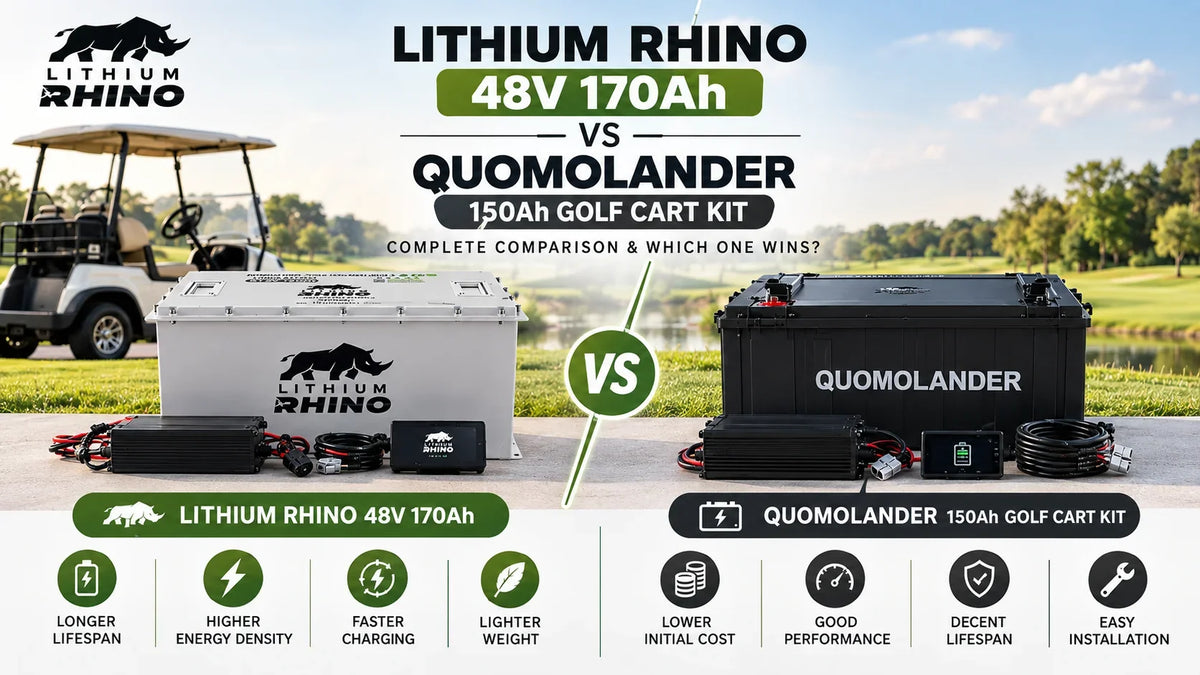
For owners who want substantially more range, the 48V 170Ah Lithium Rhino is another option. It is listed with 170Ah capacity and is marketed with a 74-mile range, 300A continuous BMS and self-heating functionality.
You can compare these options through the Lithium Rhino conversion kit range.
Final Verdict: Lithium Rhino 48V 105Ah vs Vatrer 48V 105Ah
The Lithium Rhino 48V 105Ah and Vatrer 48V 105Ah are closely matched on the fundamentals: both provide 105Ah capacity, 5,376Wh of energy and 200A continuous discharge.
The differences become more important when you look beyond the battery label.
Vatrer has a documented advantage with its IP67 rating and slightly lower published weight. It can make sense for buyers who place those specifications or upfront cost at the top of their list.
Lithium Rhino, however, brings together a 6,000+ cycle rating, complete conversion equipment, 25A charger, 40A DC converter, Bluetooth monitoring, LCD display, 8-year warranty and lifetime customer support in its 48V 105Ah conversion package.
So if your goal is simply to find a 105Ah lithium battery at the lowest possible purchase price, compare the complete specifications and package contents carefully.
If your goal is to convert your golf cart to lithium with the major components supplied together and have long-term warranty and technical support behind the system, the Lithium Rhino 48V 105Ah conversion kit is built around that use case.
Ready to compare the complete setup? Explore the Lithium Rhino 48V 105Ah Conversion Kit and check compatibility with your golf cart before ordering.
Frequently Asked Questions
Is Lithium Rhino 48V 105Ah better than Vatrer 48V 105Ah?
Both are capable 105Ah LiFePO4 golf cart batteries. Lithium Rhino's main advantages are its 6,000+ published cycle rating and the broader equipment and support included with its complete conversion kit. Vatrer's 48V 105Ah model has IP67 protection and a slightly lower published weight.
How many miles can a 48V 105Ah lithium golf cart battery provide?
Range varies considerably with the cart, terrain, speed, passenger weight, tyres and controller. Lithium Rhino currently advertises 50–65 miles for its 48V 105Ah conversion kit, while Vatrer publishes up to 50 miles for one of its 48V 105Ah configurations depending on conditions.
Is 200A continuous BMS enough for a golf cart?
For many standard golf carts, a 200A continuous BMS provides substantial current capacity. Modified carts with high-current controllers should be evaluated according to the controller's actual requirements rather than relying solely on the battery's peak-current number.
Does Lithium Rhino include a charger?
Yes. The Lithium Rhino 48V 105Ah conversion kit includes a 25A smart charger. It also includes a 40A DC converter and other installation components.
How long does the Lithium Rhino 48V 105Ah battery last?
Lithium Rhino publishes a 6,000+ cycle rating for the 48V 105Ah battery. Actual service life depends on operating conditions, depth of discharge, charging practices and other factors.
Does Lithium Rhino offer a warranty?
Yes. Lithium Rhino provides an 8-year limited warranty on its LiFePO4 batteries, subject to the published terms and registration requirements.
Does Vatrer have an advantage over Lithium Rhino?
Yes, in specific areas. Vatrer's published 48V 105Ah specification includes IP67 protection and a slightly lower weight. The right choice therefore depends on which specifications and ownership factors matter most to the buyer.
What if I need more range than a 105Ah battery?
Lithium Rhino offers larger-capacity options, including a 48V 120Ah model and a 48V 170Ah model. The 120Ah model provides 6,144Wh, while the 170Ah model is listed with 170Ah capacity and a 300A continuous BMS.


Leave a comment
This site is protected by hCaptcha and the hCaptcha Privacy Policy and Terms of Service apply.