

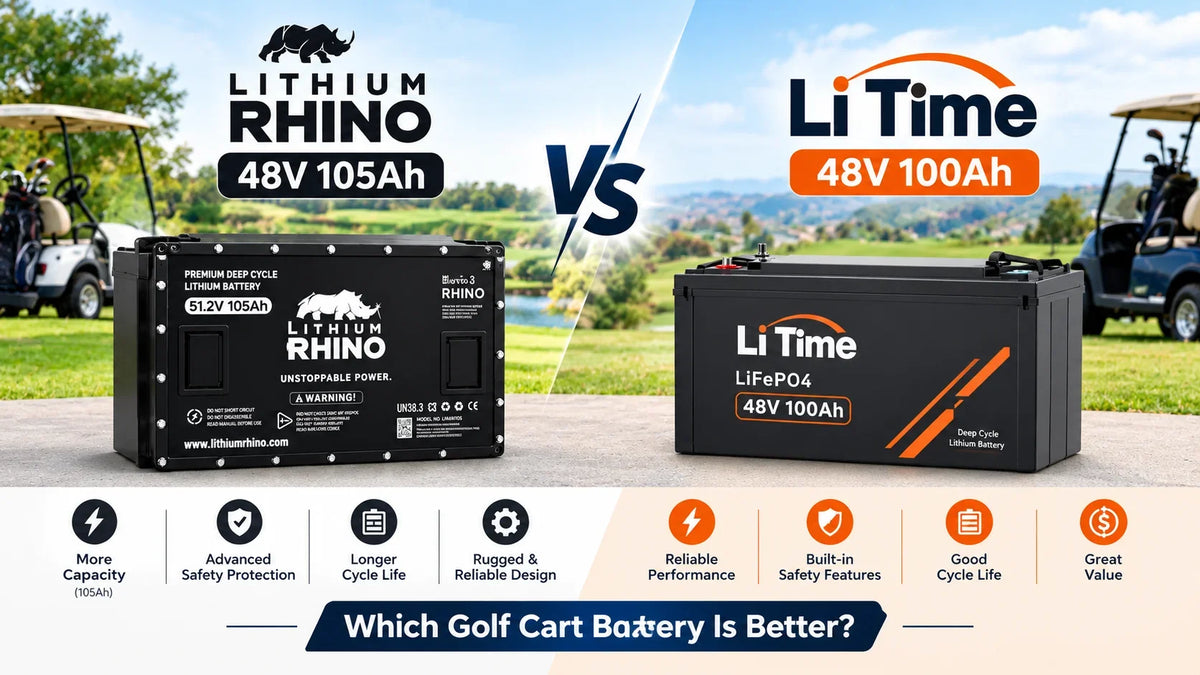
If you are comparing a Lithium Rhino 48V 105Ah battery with a LiTime 48V 100Ah battery for a golf cart, both offer a major upgrade over traditional lead acid batteries. However, the two systems are not identical.
The Lithium Rhino provides slightly more capacity, higher continuous discharge capability, a 25A charger, a 40A DC converter, a complete conversion package and an 8 year warranty. LiTime offers a lighter 100Ah battery, Bluetooth monitoring, low temperature charging protection and a 5 year warranty.
Here is a direct comparison of the two systems so you can see exactly where they differ and which specifications matter most for your golf cart.
Lithium Rhino 48V 105Ah vs LiTime 48V 100Ah: Quick Comparison
| Feature | Lithium Rhino 48V 105Ah | LiTime 48V 100Ah |
|---|---|---|
| Battery chemistry | LiFePO4 | LiFePO4 |
| Nominal voltage | 48V | 51.2V |
| Capacity | 105Ah | 100Ah |
| Total energy | 5,376Wh | 5,120Wh |
| Continuous discharge | 200A | 100A |
| Maximum/peak discharge | Up to 700A | Up to 600A for 1 second |
| Cycle life | 6,000+ cycles | 4,000 cycles at 100% DOD, 6,000 at 80% DOD |
| Bluetooth | Yes | Yes |
| Mobile app | Yes | Yes |
| LCD/display | Included with conversion kit | Battery monitor included with kit |
| Charger | 25A | 18A |
| DC converter | 40A included | Not listed as part of the standard kit |
| Conversion hardware | Complete conversion hardware | Hold-down kit and installation components |
| Low-temperature protection | See product specifications | Yes |
| Protection rating | IP65 | IP65 |
| Approx. weight | 105 lb | 82 lb |
| Published range | 50 to 65 miles depending on configuration | Up to 47 miles |
| Warranty | 8 years | 5 years |
Specifications can vary by exact configuration, so always check the product page for the version being purchased. Lithium Rhino currently lists its 48V 105Ah conversion kit with 5,376Wh of energy, 200A continuous discharge, 6,000+ cycles, a 25A charger, 40A DC converter, Bluetooth and an 8 year warranty. LiTime lists its 48V 100Ah golf cart battery at 5,120Wh, with 100A continuous discharge, Bluetooth, low-temperature protection and a 5 year warranty.
Capacity: 105Ah vs 100Ah
The first difference is capacity.
The Lithium Rhino has 105Ah, while the LiTime has 100Ah. That gives the Lithium Rhino a modest capacity advantage.
Lithium Rhino lists total energy at 5,376Wh, compared with 5,120Wh for the LiTime. That is a difference of 256Wh, or approximately 5% more rated energy for the Lithium Rhino.
In practical golf cart use, actual driving range will depend on factors such as speed, terrain, passenger weight, tyre pressure, accessories, controller settings and driving conditions. Battery capacity is therefore useful for comparison, but it should not be treated as a guaranteed mileage figure.
Power Delivery: 200A Continuous vs 100A Continuous
Capacity is only one part of a golf cart battery. The battery's ability to deliver current continuously can also affect how the cart responds under heavier loads.
Lithium Rhino lists 200A continuous discharge for its 48V 105Ah battery, with up to 700A maximum discharge listed in the product specifications.
LiTime lists a 200A BMS, but its detailed specification gives 100A maximum continuous discharge current, with up to 600A discharge for one second.
This distinction matters because a BMS rating and continuous discharge rating are not necessarily the same thing.
For normal cruising, either battery can provide substantial power. For golf carts that regularly encounter hills, heavier loads or higher-performance setups, the published continuous discharge specification is an important number to consider.
Range: How Far Can Each Battery Go?
Lithium Rhino currently advertises 50 to 65 miles for its 48V 105Ah conversion kit, while its product information also discusses real-world range on 105Ah and larger kits.
LiTime states that its 48V 100Ah golf cart battery can provide up to 40 to 50 miles under average conditions, while its current conversion kit page advertises up to 47 miles.
Neither figure should be treated as a guaranteed distance. A golf cart travelling on flat ground at moderate speed can use considerably less energy than one carrying passengers up hills at higher speeds.
The Lithium Rhino has an advantage on paper because it combines its 105Ah capacity with higher continuous discharge capability.
Charging: 25A vs 18A
Charging speed is another practical difference.
The Lithium Rhino 48V 105Ah conversion kit includes a 25A smart charger. Lithium Rhino states that the matched charger can charge the battery significantly faster than conventional lead acid systems.
The LiTime conversion kit includes an 18A charger.
The exact charging time depends on the battery's state of charge and charging conditions, but the higher-rated Lithium Rhino charger provides more charging current when using the matched system.
For owners who regularly use their golf cart and want to minimise downtime between drives, this is an important part of the comparison.
What Comes With the Conversion Kit?
This is one of the biggest differences between comparing batteries alone and comparing complete conversion systems.
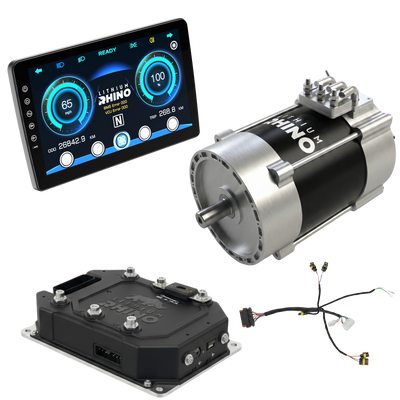
The Lithium Rhino 48V 105Ah conversion kit is designed as a complete golf cart conversion package. The current product listing includes:
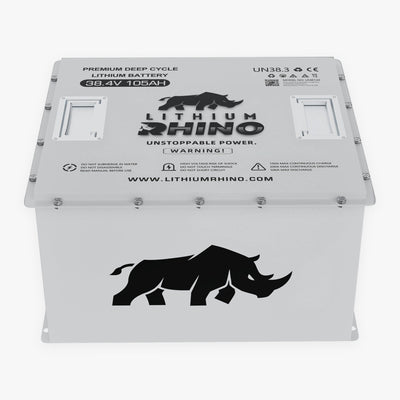
- 48V 105Ah LiFePO4 battery
- 25A smart charger
- 40A DC converter
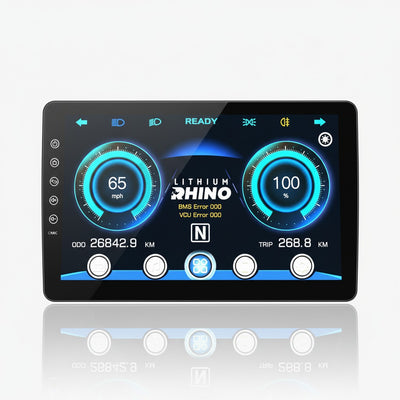
- LCD touchscreen and mount
- Charge port adapter
- Charge port adapter plate
- Heavy-gauge wiring
- Mounting brackets
- Installation hardware
- Lead-acid removal strap
- Safety equipment
- Bluetooth connectivity
- 8 year warranty
Lithium Rhino describes the kit as a complete drop-in conversion with the components required for installation.
The LiTime 48V 100Ah conversion kit includes the battery, an 18A charger, battery monitor and hold-down hardware.
If you are replacing an entire lead-acid system, the contents of the kit matter just as much as the battery specifications. A kit that includes the necessary conversion components can make the overall upgrade simpler because you do not have to source as many parts separately.
DC Converter: An Important Difference
Golf carts that use accessories and existing 12V electrical systems may require a suitable DC-to-DC converter when converting from lead acid to lithium.
The Lithium Rhino 48V 105Ah conversion kit includes a 40A DC converter as standard.
That makes the Lithium Rhino package more than just a battery replacement. The converter is already included as part of the conversion system.
When comparing complete conversion costs, it is therefore important to look at everything included rather than comparing the price of the batteries alone.
Weight: LiTime Is Lighter
One area where LiTime has a clear specification advantage is weight.
LiTime lists its 48V 100Ah battery at approximately 82 lb, while Lithium Rhino lists the 48V 105Ah conversion battery at approximately 105 lb.
That makes the LiTime battery around 23 lb lighter.
For owners who place a high priority on reducing battery weight, this difference is worth considering. However, weight is only one part of a golf cart conversion. Capacity, power delivery, charger, converter, installation components and warranty also affect the overall value of the system.
Size and Installation
The physical dimensions of the battery are also important because golf cart battery compartments differ between manufacturers and model years.
Lithium Rhino lists the 48V 105Ah battery at approximately 18 × 13.1 × 9.3 inches, while LiTime lists its 48V 100Ah battery at approximately 20.47 × 10.59 × 8.66 inches.
The dimensions are different enough that buyers should always confirm compatibility before ordering.
Lithium Rhino specifically provides model and year fitment guidance and describes its 48V 105Ah kit as a drop-in conversion for compatible carts.
Cycle Life: 6,000+ vs LiTime's DOD Ratings
Both batteries are designed for long-term lithium use, but their published cycle-life specifications are presented differently.
Lithium Rhino rates its 48V 105Ah battery at 6,000+ charge cycles.
LiTime publishes:
- 4,000 cycles at 100% depth of discharge
- 6,000 cycles at 80% depth of discharge
- 15,000 cycles at 60% depth of discharge
Depth of discharge matters when interpreting cycle-life figures. In general, repeatedly using a battery less deeply can increase the number of cycles it can deliver.
For a fair comparison, buyers should therefore look at the testing conditions behind cycle-life claims rather than comparing two numbers without considering DOD.
Bluetooth and Battery Monitoring
Both systems provide Bluetooth connectivity.
Lithium Rhino includes a Bluetooth app module that allows users to monitor battery information from a compatible smartphone. Its product page highlights real-time monitoring, state of charge, voltage and temperature information.
LiTime also offers Bluetooth 5.0 monitoring through its mobile app, allowing users to view battery status and system information.
So if smartphone monitoring is important to you, both systems provide it.
The difference is that Lithium Rhino combines app connectivity with its conversion package and an included display, giving users more than one way to monitor the system depending on the kit configuration.
Cold-Weather Protection
LiTime specifically publishes low-temperature protection specifications for its 48V 100Ah battery.
Its documentation states that charging is automatically disabled below 32°F / 0°C, with charging recovery at 41°F / 5°C. It also lists discharge protection below -4°F / -20°C.
Lithium Rhino lists an operating range of -4°F to 140°F for its 48V 105Ah battery.
If your golf cart is used regularly in very cold conditions, check the specific battery configuration and charging requirements before purchase.
IP65 Protection
Both batteries list IP65 protection.
Lithium Rhino describes the 48V 105Ah battery as IP65 rated and splash proof, while LiTime also lists IP65 protection for its 48V 100Ah battery.
This is useful for golf carts because the battery may be exposed to dust, splashes and outdoor conditions. IP ratings do not mean a battery should be submerged, so normal installation and operating precautions still apply.
Warranty: 8 Years vs 5 Years
Warranty length is another significant difference.
Lithium Rhino provides an 8 year limited warranty on its LiFePO4 batteries. Its current warranty information states that registered batteries receive six years of full coverage followed by two years of prorated coverage, subject to the warranty terms and registration requirements.
LiTime provides a 5 year warranty on its 48V 100Ah golf cart battery.
A longer warranty does not automatically mean a battery will last longer, but it does provide a longer period of manufacturer warranty coverage when the applicable conditions are met.
For buyers planning to keep the same golf cart and battery system for many years, this is an important difference between the two products.
Lithium Rhino 48V 105Ah vs LiTime 48V 100Ah: Key Differences
| Category | Lithium Rhino Advantage | LiTime Advantage |
|---|---|---|
| Capacity | 105Ah | 100Ah |
| Energy | 5,376Wh | 5,120Wh |
| Continuous discharge | 200A | 100A |
| Charger | 25A | 18A |
| DC converter | 40A included | Not listed in standard kit |
| Conversion package | More complete conversion hardware | Battery, charger, monitor and hold-down kit |
| Warranty | 8 years | 5 years |
| Weight | — | Approximately 82 lb |
| Bluetooth | Yes | Yes |
| Low-temperature protection | Product-specific | Explicitly specified |
| IP65 | Yes | Yes |
The table shows why neither product needs to be described as universally better in every category. LiTime's lower weight is useful for buyers focused on reducing vehicle weight, while Lithium Rhino's higher capacity, higher continuous discharge rating, larger charger and more comprehensive conversion package are important advantages for buyers looking at the complete upgrade.
Which Golf Cart Battery Makes More Sense?
The answer depends on what you want from the conversion.
If your main priority is having the lightest possible 48V lithium battery, LiTime's approximately 82 lb weight is an important advantage.
If you are comparing the overall conversion system, the Lithium Rhino 48V 105Ah package offers several specifications that stand out:
- More capacity at 105Ah
- 5,376Wh of rated energy
- 200A continuous discharge
- 25A smart charger
- 40A DC converter
- Complete conversion hardware
- Bluetooth monitoring
- LCD display
- 6,000+ rated cycles
- IP65 protection
- 8 year warranty
- Lifetime customer support
That combination makes the Lithium Rhino 48V 105Ah particularly compelling for golf cart owners who want a complete lithium conversion rather than simply replacing the battery pack.
Is the Lithium Rhino 48V 105Ah Worth Considering Over the LiTime 48V 100Ah?
The biggest reason to consider the Lithium Rhino is not simply the difference between 105Ah and 100Ah.
The more meaningful difference is the overall package.
Lithium Rhino combines the higher-capacity battery with 200A continuous discharge, a 25A charger, a 40A DC converter, installation hardware, an LCD display, Bluetooth monitoring and an 8 year warranty.
LiTime is a lighter alternative with strong lithium specifications, Bluetooth monitoring, low-temperature charging protection and a 5 year warranty.
For someone comparing the complete ownership experience, Lithium Rhino's included components and longer warranty can make the difference more significant than the relatively small 5Ah capacity difference.
Final Comparison
The Lithium Rhino 48V 105Ah and LiTime 48V 100Ah are both legitimate lithium golf cart upgrade options, but they are designed around slightly different priorities.
LiTime's biggest specification advantage is its lower weight, while Lithium Rhino offers more rated capacity, substantially higher published continuous discharge capability, a higher-current charger, a 40A DC converter and a broader set of conversion components in the standard kit.
For golf cart owners who want a complete 48V conversion with strong power delivery, useful included hardware, app monitoring and longer warranty coverage, the Lithium Rhino 48V 105Ah conversion kit offers a strong overall package.
You can review the current Lithium Rhino 48V 105Ah Conversion Kit to check the latest specifications, included components and fitment information.
Frequently Asked Questions
Is the Lithium Rhino 48V 105Ah better than the LiTime 48V 100Ah?
Both are LiFePO4 golf cart batteries, but Lithium Rhino offers 105Ah capacity, 5,376Wh of rated energy, 200A continuous discharge, a 25A charger, a 40A DC converter and an 8 year warranty. LiTime offers 100Ah, 5,120Wh, 100A continuous discharge, Bluetooth monitoring, low-temperature protection and a 5 year warranty.
What is the difference between 105Ah and 100Ah?
A 105Ah battery has 5Ah more rated capacity than a 100Ah battery. In this comparison, the Lithium Rhino is rated at 5,376Wh compared with 5,120Wh for the LiTime.
Which has more continuous power?
The Lithium Rhino 48V 105Ah is rated for 200A continuous discharge, while LiTime's detailed specification lists 100A maximum continuous discharge.
Which battery is lighter?
The LiTime 48V 100Ah is lighter at approximately 82 lb. Lithium Rhino lists its 48V 105Ah battery at approximately 105 lb.
Which battery has the longer warranty?
Lithium Rhino provides an 8 year limited warranty, subject to its registration and warranty terms. LiTime lists a 5 year warranty for the 48V 100Ah golf cart battery.
Does the LiTime 200A BMS mean it provides 200A continuously?
No. LiTime lists a 200A BMS but specifies 100A maximum continuous discharge for this golf cart battery. It separately lists a 600A one-second maximum discharge figure.
Does the Lithium Rhino kit include a DC converter?
Yes. The current Lithium Rhino 48V 105Ah conversion kit includes a 40A DC converter.
Which one is better for a complete golf cart conversion?
If you are comparing the complete conversion package rather than the battery alone, Lithium Rhino includes the battery, charger, DC converter, display, wiring and mounting components as part of its 48V 105Ah conversion kit.
Can I monitor either battery from my phone?
Yes. Both Lithium Rhino and LiTime offer Bluetooth-based battery monitoring through their respective apps.
Should I compare battery price or complete kit value?
For a full golf cart conversion, comparing the complete kit is more useful than comparing battery prices alone. Charger, DC converter, wiring, mounting hardware, display, support and warranty can all affect the total cost of the upgrade.

Leave a comment
This site is protected by hCaptcha and the hCaptcha Privacy Policy and Terms of Service apply.