


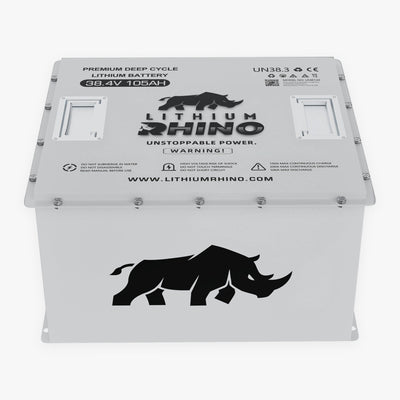
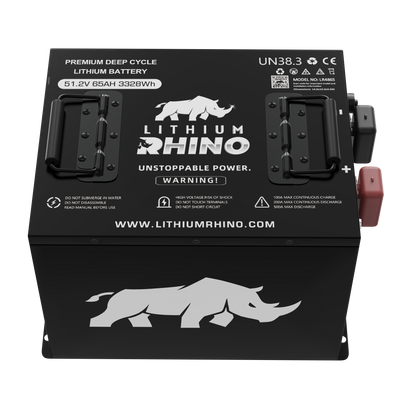
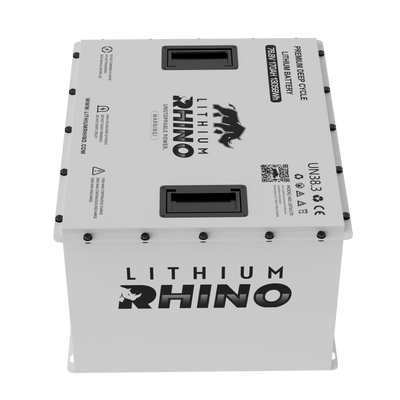

To test golf cart batteries, fully charge the pack, let it rest 6–8 hours, then use a digital multimeter to measure each battery's resting voltage and the total pack voltage. Compare every reading to the standard chart for your battery type (6V, 8V, or 12V). Any battery that reads more than 0.3V below its neighbors, or that sags hard under a load test or hill climb, is failing and needs to be replaced.
If your cart is slower than it used to be, won't climb hills, or barely makes it around the neighborhood, your batteries are the first thing to check. This is the no-nonsense Lithium Rhino guide to testing every kind of golf cart battery, lead-acid and lithium, with the exact voltages, tools, and steps you need.
⚡ Heads-up: If you're reading this because your lead-acid pack keeps failing the test, you're not alone. The average flooded lead-acid pack only lasts 3–5 years, and once one cell goes bad the whole pack starts dragging. A Lithium Rhino conversion kit replaces 4–6 lead-acid batteries with one battery that lasts 8+ years and 6,000+ cycles, and it needs zero of the testing in this guide. Take our 30-second quiz to see which Rhino fits your cart.
Why You Need to Test Your Golf Cart Batteries
Golf cart batteries are deep-cycle power sources. They charge and discharge hundreds of times a year, and every cycle takes a little life out of them. Lead-acid in particular suffers from sulfation, water loss, and uneven cell wear. Testing helps you:
- Catch a failing battery before it strands you halfway through the round
- Find out if one battery is the problem (instead of replacing the whole pack)
- Confirm whether the issue is the battery, the charger, the solenoid, or the controller
- Decide whether to keep patching the pack or finally upgrade to lithium
A typical flooded lead-acid golf cart battery lasts 3–5 years. AGM lasts 4–6. A quality LiFePO4 lithium pack like the Lithium Rhino lasts 8+ years and 6,000+ charge cycles. Testing is what tells you where you are in that lifespan and when the math stops working in lead-acid's favor.
Signs Your Golf Cart Batteries Need Testing Right Now
- Reduced range: you're not getting the miles you used to
- Slow acceleration: sluggish starts, weak hill climbs
- Voltage sag under load: the cart bogs down on inclines or with passengers
- Frequent recharging: the charger kicks on way more than it used to
- Long charge times: hours longer than before
- Hot or swollen battery cases: stop and replace immediately
- Corroded terminals or sulfur smell (lead-acid only)
- After long storage: always test before the first ride of the season
If two or more of these are happening, your pack is on borrowed time.
Tools You'll Need
| Tool | What It Does | Required For |
|---|---|---|
| Digital multimeter (rated to 200V DC) | Measures voltage | Every test, every battery type |
| Hydrometer | Measures specific gravity of electrolyte | Flooded lead-acid only |
| Battery load tester | Voltage drop under load | Real-world health check |
| Battery charger matched to your system | Charges before testing | All tests start here |
| Distilled water + funnel | Tops off cells | Flooded lead-acid only |
| Safety glasses + acid-resistant gloves | Protects you | Always |
| Wire brush + baking soda paste | Cleans corroded terminals | Lead-acid |
| Insulated wrench | Loosens/tightens cables | Always |
A digital multimeter that reads DC voltage up to at least 200V is non-negotiable — it has to cover 36V, 48V, and 72V/76V packs. Analog meters aren't accurate enough.
💡 Lithium Rhino owners skip half this list. Lithium packs have no electrolyte, no specific gravity to check, no water to top off, and the built-in Rhino BMS reports cell-level data right to your phone. Lead-acid testing is one of those chores that just goes away when you switch to lithium.
Safety First - Don't Skip This
Golf cart battery packs store enough energy to shock you, burn you with acid, or ignite hydrogen gas. Every time:
- Key off, key out. Set the run/tow switch to "Tow" if your cart has one.
- Disconnect the charger. Never test mid-charge.
- Safety glasses + acid-resistant gloves. Lead-acid batteries hold sulfuric acid.
- Ventilated area, no flames, no sparks, no smoking. Lead-acid vents hydrogen.
- Remove rings, watches, and metal jewelry. A ring across two terminals welds itself to your finger — not a joke.
- Insulated tools only.
- Clean the terminals first. Corrosion gives false readings.
If you see a cracked case, melted terminal, swollen battery, or pooled acid, stop testing. That battery is done. Pull it.
Step 1: Visual Inspection
Before touching the multimeter, look at the pack.
- Cracks, bulges, or swelling on the case → replace immediately
- Corrosion (white, blue, or green crust) on terminals → clean with baking-soda paste and a wire brush
- Loose or frayed cables → tighten or replace
- Electrolyte level (flooded lead-acid) → pull caps, fluid should cover the plates by ~1/4 inch. Top off with distilled water only, and only after charging
- Lithium packs → check for swelling, dents, or signs of overheating
A pack that fails visual inspection rarely passes electrical testing.
Step 2: Fully Charge and Rest the Pack
This is the step most DIYers skip, and it's the reason their test results lie to them.
- Charge the entire pack to 100% with a charger that matches your voltage AND chemistry (lead-acid and lithium chargers are NOT interchangeable, using the wrong one will destroy a pack fast).
- When the charger shuts off automatically, disconnect it.
- Let the pack rest for 6–8 hours. Overnight is best. Without rest, surface charge inflates your voltage reading and hides weak batteries.
If a battery won't accept a full charge after a long charge cycle, that itself is a failure indicator. You don't need to keep testing.
Step 3: Golf Cart Battery Voltage Chart
Use these as your baseline for a healthy, fully charged, rested battery.
Individual Battery Voltage (Resting)
| Battery | Healthy Resting Voltage | Replace If Below |
|---|---|---|
| 6V flooded lead-acid | 6.3 V – 6.4 V | 6.0 V |
| 8V flooded lead-acid | 8.4 V – 8.5 V | 8.0 V |
| 12V flooded lead-acid | 12.6 V – 12.8 V | 12.0 V |
| 12V AGM lead-acid | 12.8 V – 13.0 V | 12.2 V |
| 12V LiFePO4 (lithium) | 13.3 V – 13.6 V | 12.8 V |
Total Pack Voltage (Resting)
| System | Healthy Pack Voltage | Diagnose / Replace Below |
|---|---|---|
| 36V (six 6V batteries) | 38.0 V – 39.0 V | 36.0 V |
| 48V (six 8V or four 12V) | 50.4 V – 51.0 V | 48.0 V |
| 48V (eight 6V) | 50.4 V – 51.2 V | 48.0 V |
| 48V LiFePO4 | 53.0 V – 54.6 V | 52.0 V |
| 72V / 76V lead-acid | 76.3 V – 78.0 V | 72.0 V |
| 76V LiFePO4 (Rhino) | 83.2 V – 87.6 V | 80.0 V |
📊 A quick note on lithium voltage: LiFePO4 has a flat voltage curve. A lithium pack at 90% state of charge and 30% state of charge read almost the same on a multimeter. Voltage alone isn't enough, you need BMS data. Every Lithium Rhino kit comes with app-connected BMS data showing real state of charge, cell balance, temperature, and cycle count, so you never have to guess.
Step 4: Test the Pack with a Multimeter
A) Total Pack Voltage
- Set the multimeter to DC Voltage, range that exceeds your pack (200V DC works for 36V, 48V, and 72V/76V).
- Red probe → positive (+) terminal of the first battery in the series chain.
- Black probe → negative (–) terminal of the last battery in the chain.
- Read the voltage.
A healthy 48V lead-acid pack reads 50.4–51.0V at rest. Below 48V means the pack isn't fully charged or one or more batteries are failing.
B) Each Individual Battery
Total pack voltage can look "fine" even when one battery is dead, the others mask it. You have to test each battery one by one.
- Red probe on the positive (+) post, black probe on the negative (–) post of the same battery.
- Write down every reading.
- Compare.
Diagnostic rules:
- All batteries should be within 0.2V of each other (lead-acid) or 0.1V (lithium).
- Any battery more than 0.3V below its neighbors is failing.
- Any battery below the "Replace If Below" threshold in the chart above is bad.
Real example for a 36V cart (six 6V batteries): Readings: 6.35, 6.34, 6.36, 6.33, 5.85, 6.34 Battery #5 is the culprit. It's dragging the whole pack down. The fix is replacing it, but if the pack is more than 2 years old, the new battery will burn out fast trying to keep up with five tired ones. That's the lead-acid trap, and it's exactly why people switch to a single lithium battery instead.
Step 5: Hydrometer Test (Flooded Lead-Acid Only)
A hydrometer measures specific gravity, the density of the acid relative to water. It's the single most accurate health check for flooded lead-acid because it tests each cell, not just the battery overall.
⚠️ Flooded lead-acid only. Never use a hydrometer on AGM, gel, or lithium batteries.
How to Use It
- Battery must be fully charged. Do not top off with water before testing.
- Gloves and glasses on.
- Squeeze the bulb, insert tip into a cell, release.
- Hold vertically at eye level, read where the float meets the fluid.
- Return the fluid to the same cell. Repeat for every cell in every battery.
Reading Specific Gravity
| Reading | State of Charge |
|---|---|
| 1.275 – 1.300 | 100% (healthy, fully charged) |
| 1.225 – 1.265 | ~75% — OK to load test |
| 1.150 – 1.220 | Discharged — recharge first |
| Below 1.120 | Deeply discharged or damaged |
Most important rule: if any two cells differ by more than 0.050 (50 points) for example, one reads 1.275 and another 1.220 that battery has an internal short. Replace it. This is the Trojan/industry standard.
Step 6: Load Test (The Real Health Check)
Voltage tells you state of charge. A load test tells you whether the battery can actually do work. A battery can read perfect voltage at rest and collapse the moment your foot touches the pedal.
Option A: Battery Load Tester
- Fully charged battery, clamps on (red to positive, black to negative).
- Apply load for 10–15 seconds at the rated test current (~50% of CCA or amp-hours).
- Watch the voltage live.
Pass / fail thresholds:
- 6V battery should hold above 4.8 V under load
- 8V battery should hold above 6.4 V under load
- 12V battery should hold above 9.6 V under load
Drop below these or sag more than 1.5–2V from resting voltage and the battery is done.
Option B: The Hill Climb Test (No Special Tools)
If you don't have a load tester, your golf cart's hill is the load tester.
- Fully charge the pack.
- Hook the multimeter across the whole pack (or one suspect battery).
- Drive uphill or accelerate hard while someone watches the meter.
- Note the voltage drop.
Diagnostic rules:
- Lead-acid: pack drops more than 3–5V under load → high internal resistance, failing cell.
- Lithium: voltage stays almost flat. Sudden drop to 0V means the BMS tripped to protect the pack (sign of cell imbalance, over-temp, or over-discharge).
🦏 This is where lithium owners win. A Lithium Rhino pack holds full voltage almost flat from 100% down to 10% state of charge. You get the same top speed and hill-climbing power on the last hole as the first. With lead-acid, your back nine is always slower than your front nine.
Step 7: Testing Lithium (LiFePO4) Golf Cart Batteries
Lithium needs a different approach. Multimeter voltage isn't enough because the curve is flat. Here's what to check instead:
1. BMS App Data (Most Important)
Every modern lithium golf cart battery including every Lithium Rhino kit, connects to a smartphone app and shows:
- Real state of charge (%)
- Individual cell voltages
- Pack temperature
- Total cycles used
- Any fault codes
This is the most accurate health check available period.
2. Resting Pack Voltage
- 48V LiFePO4: rest between 53.0–54.6V when fully charged
- 12V LiFePO4: rest at 13.3–13.6V
3. Cell Balance
Cells inside the pack should be within 0.05V of each other. The Rhino BMS shows this automatically.
4. Capacity / Runtime Test
Fully charge, drive a known route, compare to spec. If your pack delivers less than 80% of rated runtime, capacity has degraded.
5. Visual Check
Look for swelling, heat during charging, or fault codes. Healthy lithium runs cool and silent.
If you're testing a lithium pack and it's giving you trouble, check the warranty first. Lithium Rhino covers every kit for 8 full years. See the full warranty details.
Pass / Fail Quick Reference
| Test | Pass | Fail (Replace or Diagnose) |
|---|---|---|
| Visual inspection | No cracks, leaks, swelling, heavy corrosion | Any of those |
| Resting voltage (lead-acid) | At or above chart spec | More than 0.3V below neighbors |
| Specific gravity (flooded) | All cells within 0.050 of each other | Any two cells differ >0.050 |
| Load test | Voltage holds above 80% nominal for 15 seconds | Sags below threshold or drops >2V |
| Hill climb | Lead-acid drops <3V; lithium stays flat | Bigger drop, or lithium BMS shutdown |
| Lithium BMS | Cells balanced within 0.05V; no faults | Imbalance, repeated faults, lost capacity |
Why Did My Battery Fail? Common Causes
- Sulfation: sulfate crystals form on lead plates when a lead-acid battery sits discharged. #1 killer of golf cart batteries.
- Water loss: flooded plates exposed to air corrode permanently.
- Wrong charger: using a lead-acid charger on lithium (or vice versa) destroys packs fast.
- Deep discharge: repeatedly taking lead-acid below 50% cuts lifespan in half.
- Heat: temperatures above 95°F accelerate degradation in both chemistries.
- Old age: even a perfect pack wears out. Plan replacement at year 4–5 for lead-acid, year 8–10 for LiFePO4.
Notice how many of these are lead-acid-specific problems. Sulfation, water loss, deep-discharge damage, they don't exist with LiFePO4. That's not marketing; that's chemistry.
How Often Should You Test Golf Cart Batteries?
- Flooded lead-acid: voltage + electrolyte monthly, full multimeter + hydrometer every 3 months, load test at start and end of every season
- AGM: voltage monthly, load test every 6 months
- LiFePO4 (Rhino): glance at BMS app monthly, full diagnostic every 6–12 months (and honestly, the app does most of it for you)
- After long storage: always test before the first ride
When to Replace vs. Recondition vs. Upgrade
The honest decision tree:
- Pack is under 1 year old, one bad battery: replace just the bad one (and figure out what killed it was it the charger? Watering schedule?).
- Pack is 2–4 years old, lead-acid: weigh the cost. A new battery in an old pack works harder than the others and often dies within months. Many owners replace the whole pack or skip lead-acid entirely.
- Pack is 4+ years old, lead-acid: replace the entire pack. Mixing old and new lead-acid in series shortens the new battery's life almost every time.
- Pack is 4+ years old AND this is your second or third lead-acid replacement: stop. Do the math. You've already spent more on lead-acid batteries than a single Lithium Rhino kit would have cost you in year one. See which Rhino fits your cart.
- Lithium pack with a single bad cell, under warranty: contact the manufacturer. Lithium Rhino's 8-year coverage means most issues are a warranty claim, not a repurchase.
The Lead-Acid vs Lithium Lifetime Cost Reality
| Lead-Acid (Flooded) | Lithium Rhino | |
|---|---|---|
| Lifespan | 3–5 years | 8+ years (6,000+ cycles) |
| Maintenance | Water top-off, terminal cleaning, equalization charge | Zero |
| Testing required | Monthly voltage, quarterly hydrometer, seasonal load | Glance at the app |
| Weight | 60–70 lb per battery × 6 = ~400 lb | 1 battery, far lighter |
| Replacements in 8 years | 2–3 full pack swaps | None |
| App / BMS data | None | Full real-time data |
| Warranty | 6–18 months typical | 8 years full coverage |
That's the calculation more and more owners are running — and it's why 10,000+ cart owners have already switched to Lithium Rhino conversions.
Take the 30-second battery quiz → Shop 48V conversion kits → Shop 36V conversion kits → Shop 72V conversion kits →
Frequently Asked Questions
How do you know if a golf cart battery is bad?
A golf cart battery is bad if its resting voltage is more than 0.3V below other batteries in the pack, its specific gravity differs from other cells by more than 0.050, or it drops below 80% of its nominal voltage during a 15-second load test. Visible swelling, leaking, or heavy corrosion also mean the battery is bad and unsafe.
How do you test a 48 volt golf cart battery system?
Fully charge the pack, let it rest 6–8 hours, then use a multimeter to measure total pack voltage across the first positive and last negative terminals. A healthy 48V lead-acid pack reads 50.4–51.0V at rest. Then test each individual battery (six 8V or four 12V) and confirm they're within 0.2V of each other. Finish with a load test or hill-climb test.
How do you test a 36 volt golf cart battery system?
Same process. A 36V lead-acid pack uses six 6V batteries; healthy resting pack voltage is 38.0–39.0V. Each 6V battery should read 6.3–6.4V. Any battery below 6.0V is failing.
What voltage should a fully charged 6V golf cart battery be?
A fully charged, rested 6V flooded lead-acid battery should read 6.3V to 6.4V. Anything below 6.0V indicates a failing battery.
What should an 8V golf cart battery read fully charged?
A fully charged, rested 8V flooded lead-acid battery should read 8.4V to 8.5V. Below 8.0V indicates failure or deep discharge.
Can you test a lithium golf cart battery with a multimeter?
You can measure the voltage of a lithium battery with a multimeter, but because LiFePO4 has a flat voltage curve, voltage only tells you whether the pack is roughly charged — not whether it's healthy. The accurate way to test lithium is through the BMS app data, plus a runtime/capacity check. Every Lithium Rhino kit gives you full app-connected BMS data out of the box.
Why is my golf cart slow even after a full charge?
The most common cause is one or more weak batteries dragging the whole pack down, total pack voltage looks fine, but the weak battery collapses under load. Other causes: failing solenoid, worn motor brushes, low tire pressure, or a faulty controller. Test each individual battery first.
How long do golf cart batteries last?
Flooded lead-acid: 3–5 years with maintenance. AGM: 4–6 years. LiFePO4 lithium: 8–10+ years and 6,000+ cycles, compared to 500–1,200 cycles for lead-acid. See how long 48V batteries actually last.
Is it worth replacing just one bad battery?
Only if your pack is under a year old. After 2+ years, the older batteries have less capacity than a new one, which forces the new battery to overwork and fail early. Most owners get better results replacing the whole pack or upgrading to a single lithium battery that lasts 2–3x longer.
Do I need to disconnect the batteries before testing?
No. Voltage testing across each battery's posts works with the pack wired up, as long as the key is off and the charger is disconnected. Only disconnect when removing batteries, using load testers that require isolation, or when there's visible damage.
What's the easiest way to never have to test golf cart batteries again?
Upgrade to lithium. LiFePO4 has no electrolyte to check, no water to top off, no specific gravity to measure, no sulfation to fight. The Rhino BMS reports everything to your phone. Find your Rhino in 30 seconds.
The Bottom Line
Testing golf cart batteries is straightforward as long as you do the steps in order: visual inspection, full charge, 6–8 hour rest, multimeter on the pack, multimeter on each individual battery, hydrometer (for flooded lead-acid), and a load or hill-climb test. Skip a step and you'll replace the wrong battery or worse, replace a healthy pack when the real problem was a charger or controller.
Track your readings every test cycle. A 6V battery that reads 6.34V this quarter and 6.20V next quarter is on its way out, even if both numbers still look "fine" on the chart. The trend is what tells the truth.
And if you're tired of running this drill every season measuring voltages, hauling hydrometers, replacing one bad battery just to watch the next one fail there's a better path. Lithium Rhino kits eliminate the testing routine entirely: 8-year warranty, 6,000+ cycles, real BMS data on your phone, and one battery instead of six.



Leave a comment
This site is protected by hCaptcha and the hCaptcha Privacy Policy and Terms of Service apply.